

You’ve got time now. The career is done, the kids are grown, and you’re finally supposed to enjoy yourself. But here’s what nobody tells you about retirement: it can get quiet. Really quiet.
The problem isn’t boredom, exactly. It’s that nagging feeling when you realize you’ve stopped stretching your brain the way you used to. Meanwhile, your neighbor mentioned taking an online photography class and suddenly seems busier than when she was working.
Why This Actually Matters for Your Brain
Here’s something that’ll get your attention. Research from a 2025 study found that older adults who learned new skills showed cognitive abilities similar to people 50 years younger after just one year. Not a little better. College-student better.
That’s not some wellness guru making promises. Scientists tracked seniors through actual university-level coursework and measured the results. The folks who learned multiple skills simultaneously, like drawing and Spanish and photography all at once, saw improvements in memory and attention that stuck around.
Help more seniors learn about technology in the New Year by supporting TheSeniorTechie.
Another study following 2,802 older adults over 10 years found computerized cognitive training reduced dementia risk by 29 percent compared to a control group. The people who did the most training sessions? Their dementia rate was 5.9 percent versus 10.8 percent for those who did nothing.
Your brain responds to challenge at any age. The trick is giving it the right kind.
The Loneliness Problem Nobody Talks About
Let’s be honest. Retirement sounds great until you realize half your social life came from work. You’re not getting those daily conversations anymore. You’re not solving problems with other people anymore.
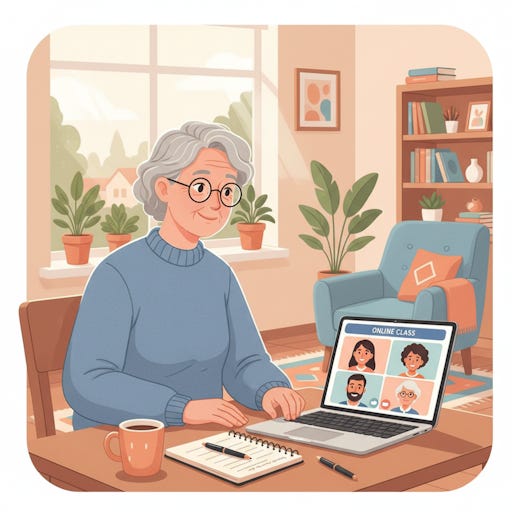
Online learning platforms create actual communities. After completing 15-week online courses, 82 percent of older students reported stronger relationships through virtual discussion boards and group projects. These aren’t just forums where you lurk. They’re live classes where instructors know your name and classmates wait to hear what you think about the assignment.
One program saw 84 percent of participants credit online learning with improving their overall quality of life. That’s not about mastering a programming language like Python or finally understanding economics. It’s about having people to talk to who share your interests.
What’s Actually Out There (And What It Costs)
The landscape changed while we weren’t paying attention. Right now, 81 percent of older adults access the internet daily. The platforms followed that shift.
Senior Planet from AARP offers completely free live online classes on everything from finance to wellness. You can call their tech support hotline if you get stuck. No shame in that. They built the program specifically for people who didn’t grow up with this stuff.
Coursera partners with over 300 universities including Stanford, Duke, and Google. You can audit most courses free. If you want the certificate, it runs $50 to $100. The videos let you adjust playback speed and include full transcripts, which helps if your hearing isn’t what it used to be.
EdX offers courses from MIT, Berkeley, and Harvard. Again, you can audit free. Khan Academy gives you everything at no cost. Udemy works on one-time purchases with lifetime access, and they run sales constantly.
The Part Where You Actually Start
Forget diving into advanced calculus or trying to become fluent in Mandarin by February. That’s not how this works.
Pick something you’re genuinely curious about, not what you think you should learn. The technology barrier? Smaller than you think. After taking online courses, 57 percent of seniors aged 55 and older rated their confidence with digital technology as very high. You learn the platform while you learn the subject. Two skills, one effort.
Most platforms start you with orientation sessions. Senior Planet specifically includes guides with tips on navigating online learning. YouTube has tutorials for everything. Yes, YouTube is for more than funny dog videos.
What Happens When You Stick With It
The real shift happens around week three or four. That’s when the material clicks and you realize you’re actually having conversations with people in other states about topics you barely knew existed a month ago.
The cognitive benefits compound. A nationally representative study of U.S. older adults found that attending educational courses was associated with better cognitive function over time, even after accounting for health, lifestyle, and social factors. Your brain builds new pathways. It has to, because you’re asking it to do new things.
Two-thirds of seniors rated their 15-week online learning experience as very effective. That number comes from people who actually finished courses, not marketing materials. These were regular folks who started not knowing if they could handle online learning and came out the other side surprised at themselves.
Your Next 30 Minutes
Don’t overthink this. Right now, before you close this tab and forget about it, do one thing: visit Senior Planet’s website or search Coursera for a topic you’ve always wondered about.
You’re not committing to anything. You’re browsing. But you’re also giving yourself permission to be curious again, which is something retirement can accidentally steal if you’re not careful.
The new year’s coming, whether you learn something or not. Might as well have a better brain and some new people to talk to when it arrives.


The benefits of learning are huge, particularly for retirees. Great article.
Loved the post! I'm still working as a teacher, learning every day. Sometimes I fell like I'm slipping, but that could be because I'm working, learning how to market a book and writing another.