

Most of you will never move to Asheville, North Carolina. You may never visit. You may have no particular opinion about it one way or the other.
That’s fine. Read on anyway. Most of us spent 30 years living where the job was. This book is about what happens when you finally get to choose.
I wrote a book called Don’t Move to Asheville: A Ruthlessly Honest Guide That Will Ruin Everywhere Else.* And the truth is, it’s not really about a city. It’s about something most of us have felt at least once: the strange, specific experience of finding a place that fits so completely it quietly recalibrates everything else.
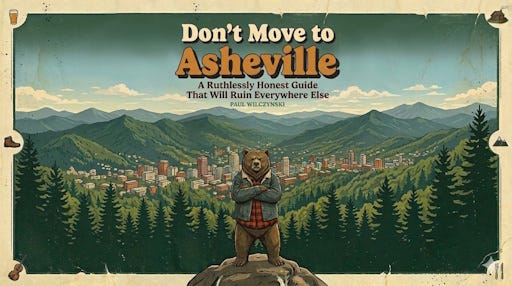
You know what I mean. The place you moved to and couldn’t explain to anyone who hadn’t been there. The place you drove away from and kept thinking about for years. Or maybe the place you’re still looking for, quietly, while your current address technically works but never quite feels like the answer.
That’s what this book is about.
The Title Is a Warning I Had No Business Writing
I moved to Asheville in 2014, after stops in Boston and Charleston. I consider it one of the best decisions of my life, which makes me an unreliable narrator of a book structured entirely as a warning.
Every chapter leads with a reason to stay away. Don’t move here if you like boring food. Don’t move here if you hate the outdoors. Don’t move here if you think small towns stay small. Nine chapters, nine cautions, all written by someone who stayed and has no regrets about it.
If the premise makes you smile a little, you’ll like this book.
Don’t Move to Asheville* is available now.
📖 Paperback — $18.95 on Amazon
📱 eBook — $7.99 (all platforms)
What’s Actually Inside
The writing tries to be honest in a way most books about places aren’t. There’s a chapter on healthcare that I wish I didn’t have to write but did. There’s a cost-of-living section that tells you plainly who the math rewards and who it punishes. The tourism pressure, the housing strain, the ways the city is changing faster than it planned for — none of that gets smoothed over.
But there’s also the story of a retired civil engineer who opened Asheville’s first craft brewery in a rented basement in 1994, using repurposed dairy equipment, and accidentally started a cultural movement that now draws Michelin inspectors to a mountain city of 95,000 people.
There are 4,000 miles of trout streams and a river that predates the mountains it runs through by 150 million years. There’s a food culture built on actual relationships with actual farms that proved harder to uproot than anyone expected when Hurricane Helene hit in 2024 — and came back stronger on the other side of it.
There are also genuinely funny passages. A section on the financial consequences of living near world-class mountain biking trails will resonate with anyone who has ever let a hobby get away from them. The weather chapter has opinions. The chapter on fitting into a city that attracts a very particular kind of person is something I’m quietly proud of.
Why I Think You’ll Enjoy It
Writing about place often isn’t really about the place. It’s about recognition — the feeling of reading something and thinking, yes, that’s exactly it, I just never had the words for it.
If you’ve ever found somewhere that raised your baseline permanently and then couldn’t fully explain the loss when you left, this book will feel familiar. If you’ve ever wondered whether you’re living in the right place, or whether it’s too late to find out, this book has something to say to you. And if you just want something I modestly think is well-written, specific, and occasionally maddening, written by someone with strong opinions and no interest in flattering anyone unnecessarily — well. Here we are.
If you do pick it up, I’d genuinely like to know: where’s the place you still think about?


What a great idea!
Congratulations on the book! The idea of place and where one fits; the notion of belonging; and the power of choice in the matter -- all compelling reasons to buy and read your book.
This hits home for me, as I have been wanting to move for the last couple of years, and the real estate market where I live has been up and down and sideways to the extent that selling has proved more difficult that we thought it would be. That being said, we are not giving up hope. We found a place that feels like "home." A last chapter home. I realize that no place is without its flaws, but for my husband and I, the pro column far outweighs the con column.
Thanks for writing this book that explores what I think is a universal theme, that of the longing for belonging. Now I'm going to go order your book!