

You’ve probably felt it even if you haven’t seen the numbers: groceries cost more, prescriptions cost more, and that Social Security check just doesn’t stretch the way it used to. Turns out the data backs up that gut feeling.
So Is It Actually Getting Worse?
Yes. Under the Supplemental Poverty Measure, the rate for older adults hit 15% in 2024, up from 14% the two years before that, according to Census Bureau data cited by the National Council on Aging. That’s over 9.2 million older Americans struggling to cover food and medicine. And here’s the part that stings: seniors were the only age group where poverty went up in 2024—everybody else held steady or improved.
During the pandemic, temporary boosts to programs like SNAP actually pushed senior poverty down to 9.5%. Once that help disappeared, the numbers climbed right back. Recent cuts to SNAP and Medicaid aren’t going to help matters either.
Premium subscribers get full access to all Premium Guides (including our monthly brain health and AI For Seniors Deep Dives) plus lifetime tech support from our partner TechMaid (a $50/year value, included for free).
Why Does This Keep Happening to Seniors Specifically?
A few things are stacking up at once, and none of them are going away on their own.
Inflation since the pandemic has hit fixed incomes especially hard
Caregiving costs are draining savings. Nearly half of family caregivers, including 14 million seniors themselves, report serious financial stress from caregiving
Poverty rates rise with age; by 80-plus, 57% of seniors live below twice the poverty line under the fuller SPM measure, compared to 36% for those 65 to 69
Women and Black and Hispanic seniors face notably higher poverty rates than the overall senior population
Social Security remains the single biggest thing keeping people out of poverty—it lifted 28.7 million people above the line in 2024. But it wasn’t designed to be someone’s entire retirement plan, and for millions, it’s become exactly that.
Where Does Technology Actually Fit In?
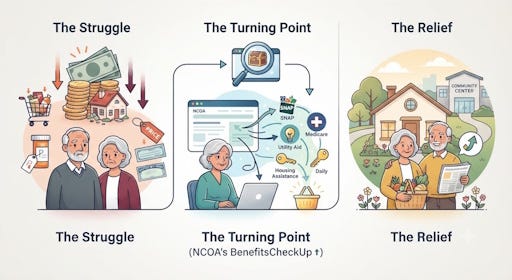
I’m not going to tell you an app is going to fix a broken safety net. It won’t. But there is one tool that genuinely earns a spot on your bookmarks bar: The National Council on Aging’s BenefitsCheckUp.
Here’s why it matters. Billions of dollars in benefits go unclaimed every year simply because older adults don’t know programs exist or find applying too confusing. BenefitsCheckUp is free, confidential, requires no registration, and matches you to over 2,500 federal, state, and local programs—SNAP, Medicare Savings Programs, Medicare’s Extra Help for prescriptions, utility assistance, housing help—based on your ZIP code and situation.
How Do You Actually Use It?
You enter your ZIP code, answer some questions about your income and situation, and it spits out a personalized report you can print, email, or use to apply directly online. If the technology itself trips you up, there’s a live chat feature and a Benefits HelpLine you can call instead—1-800-794-6559.
Here’s a real-world example of the gap this closes: a widow on a fixed income might not realize she qualifies for a Medicare Savings Program that would cover her Part B premium, freeing up over $1,700 a year. BenefitsCheckUp exists specifically to surface things like that.
What About Everyday Money-Saving Tools?
Beyond benefits screening, a few practical tech habits help stretch a limited budget:
Prescription comparison tools like GoodRx can cut drug costs before you even fill a prescription
Grocery and EBT-linked discount programs (Amazon, Walmart, and others) offer reduced-rate memberships for benefit recipients
Setting up automatic bill pay avoids late fees that quietly eat into a tight budget
None of this replaces policy fixes. NCOA is specifically pushing Congress to fund the Medicare Improvements for Patients and Providers Act and to strengthen Social Security itself. Technology can help you claim what you’re already owed—it can’t create money that isn’t there.
What Should You Actually Do Tomorrow?
Go to benefitscheckup.org and spend ten minutes on it. Even if you think you don’t qualify for anything, you might be wrong—and if you’re helping a parent or older relative, do it for them too. For a broader gut-check on scams targeting seniors’ finances, the FBI’s IC3 site (ic3.gov) is worth bookmarking as well, and Apple’s own support pages have solid guides on setting up accessibility features if the screen size or navigation is what’s holding you back (support.apple.com).
Frequently Asked Questions
Q: Does Medicare cover the cost of BenefitsCheckUp or similar screening tools?
A: No cost is involved—BenefitsCheckUp is entirely free and doesn’t require Medicare or any insurance to use.
Q: Is my information safe when I use BenefitsCheckUp?
A: Yes, the tool is confidential and doesn’t require you to create an account or register.
Q: What if I don’t have a computer or feel uncomfortable using one?
A: You can call the Benefits HelpLine at 1-800-794-6559 and a specialist will walk you through it by phone.
Q: Are unclaimed benefits a small problem or a big one?
A: It’s a big one—NCOA estimates billions of dollars in benefits go unclaimed by eligible older adults every single year.
Got a parent or neighbor you think might qualify for help but has never checked? What’s stopping you from sitting down with them this week?

