

You probably know that eating better is “good for you.” You’ve heard that a thousand times. But here’s something more specific, and honestly more motivating: a new study says the right diet changes can make your cells look younger, and they can do it in as little as four weeks.
That’s not a supplement company’s marketing copy. That’s a peer-reviewed study published in Aging Cell.
What Did the Study Actually Find?
Researchers at the University of Sydney tracked 104 adults between 65 and 75 years old across four different diet plans for one month. Three of those four groups showed measurable reductions in biological age markers, things like blood pressure, insulin, cholesterol, and C-reactive protein.
The diet that produced the strongest results? An omnivorous plan higher in complex carbohydrates and lower in fat, with about 14% of calories from protein, 28-29% from fat, and 53% from carbohydrates. Plant-based protein sources outperformed animal-based ones across the board.
The one group that saw no meaningful change was eating the high-fat omnivorous diet closest to what they were already eating before the study began. Draw your own conclusions there.
Stay confident with your tech, and keep your mind sharp. Premium subscribers get every Premium Guide, exclusive Brain Health and AI For Seniors Deep Dives, and full access to TechMaid for lifetime tech support (normally $50/year—yours free).
What Even Is “Biological Age”?
Your chronological age is your birthday. Your biological age is how old your body’s cells actually act. The two numbers don’t always match.
Scientists measure biological age using biomarkers, not just the date on your driver’s license. A UCSF study found that every gram of added sugar you eat is associated with an increase in your epigenetic (cellular) age, even if the rest of your diet is healthy. Researchers estimated that cutting 10 grams of added sugar daily could be equivalent to turning back that biological clock by about 2.4 months, if sustained over time.
That’s not nothing. That’s one less daily soda.
Where Does Your Phone Come In?
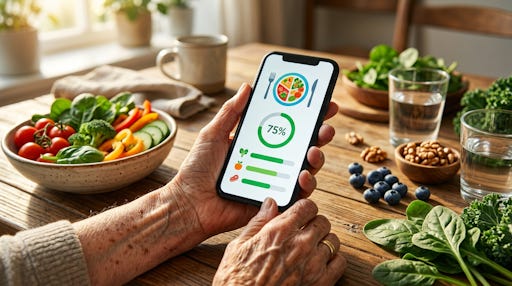
Knowing you should eat more plants and fewer saturated fats is one thing. Actually doing it, consistently, without a nutritionist on speed dial, is another. This is where a few solid apps actually earn their keep.
Here are three worth looking at:
MyFitnessPal (free, with premium option): The gold standard for food logging. Scan a barcode, log a meal, see your macros. It’s not glamorous but it works. The database is enormous.
Cronometer (free, with premium): Rated best overall calorie counter by several independent reviewers. Goes deeper on micronutrients, which matters more as we age.
Senior Nutrition App (designed for 50+): Built specifically for older adults. Tracks nutrition, monitors health metrics like glucose and heart rate, and supports fasting protocols if that’s something your doctor has recommended.
If you have a Samsung phone, Samsung Health is already on your device and covers basic nutrition tracking alongside heart rate and step counting.
One Honest Caveat
The University of Sydney researchers were careful to say this study is an early indication, not a guarantee. It had 104 participants and lasted only four weeks. Larger, longer studies are still needed to know whether these biological changes actually reduce disease risk over time.
So don’t throw out your current medications or cancel your next doctor’s appointment based on this. But do consider that the direction the science is pointing is pretty clear: less processed fat, less added sugar, more plants, more complex carbs.
Your phone can help you keep score.
What’s the Easiest First Step?
Pick one meal today, just one, and log it in MyFitnessPal or Cronometer. See what it actually contains. Most people are genuinely surprised.
You don’t have to overhaul your entire diet this week. You just have to start paying attention.
For reporting potential food or supplement fraud, you can contact the FDA at reportfraud.ftc.gov. For evidence-based nutrition guidance, Apple’s Health app links directly to resources from the NIH National Institute on Aging.
Frequently Asked Questions
Q: Does this mean I should go completely vegetarian to lower my biological age?
A: Plant-based protein sources did outperform animal-based ones in the study, but three of the four diet groups, including some omnivores, still saw improvements. You don’t have to give up meat entirely; reducing it and swapping in more legumes, whole grains, and vegetables appears to be what matters most.
Q: Are these diet tracking apps safe to use with my health data?
A: Reputable apps like MyFitnessPal and Cronometer have privacy policies you can review before signing up. Limit the permissions you grant the app and avoid sharing sensitive health data you’re not comfortable with.
Q: How is biological age actually measured in these apps?
A: Most consumer diet apps don’t measure biological age directly. They track the inputs (what you eat) and some health metrics. Apps like SuperAge use wearable data like resting heart rate and VO₂ max to estimate biological age, but those are separate from a simple diet tracker.

