

Retirement savings don’t stretch like they used to.
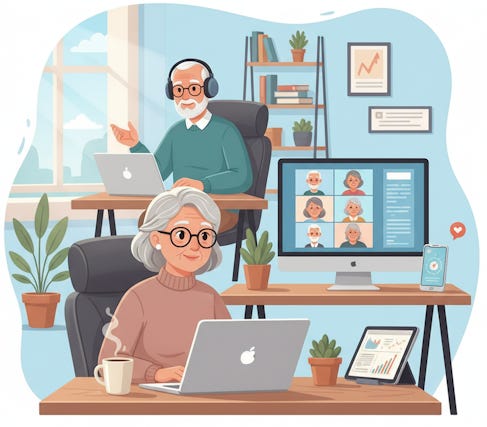
Social Security might cover the basics, but what about the travel you promised yourself? The hobbies you wanted to explore? Even just breathing room in the monthly budget? According to recent surveys, three in ten working Americans aren’t confident they’re financially prepared for retirement. Once you’re already there, that feeling doesn’t magically disappear.
Paid subscribers get full access to Premium Guides - including a monthly deep dive into brain health - plus LIFETIME access to free tech support from our partner Tech Maid.
But here’s what’s changed: technology has quietly opened doors that didn’t exist even five years ago. You don’t need to be a programmer or understand cryptocurrency. The online economy now values exactly what you already have—decades of experience, reliability, and the ability to get things done.
This isn’t about becoming an influencer or learning TikTok dances. It’s about monetizing skills you’ve been using your entire career, on your own schedule, from your kitchen table.
Your Experience Is the Product
The beauty of online work in 2026? Companies desperately need what retirees naturally possess.
Think about it. You know how to communicate professionally. You’ve managed projects, solved problems, dealt with difficult people. You can write a coherent email, organize information, and show up when you say you will. These aren’t special skills to you—they’re just Tuesday.
To someone running a small business from their laptop? That’s gold.
Technology has lowered the barriers to entry for turning expertise into income. You don’t need overhead, an office, or even particularly advanced tech skills. What you need is the willingness to reframe what you already know how to do.
Virtual Assistant Work: The Gateway Drug
Virtual assistant roles have become the ideal entry point for retirees wanting flexible work.
What does a virtual assistant actually do? The basics include email management, scheduling appointments, data entry, research, and customer service. If you’ve ever managed a household calendar or helped coordinate family events, you’re already halfway there.
The median hourly wage sits around $21.19, with room to grow based on specialization. Companies like Belay and Boldly hire experienced professionals for part-time, long-term roles. Freelance marketplaces like Upwork and Fiverr let you build your own VA business, starting with small projects and growing over time.
You’re not signing up for a 40-hour workweek unless you want to. Most retirees prefer part-time arrangements that offer flexibility, purpose, and enough income to supplement their lifestyle.
Teaching What You Already Know
Online tutoring and teaching have exploded. Students can now receive instruction across any distance.
Platforms like Tutor.com, Wyzant, and Skillshare connect you directly with people who want to learn what you know. An educational background helps but isn’t required. You could teach academic subjects, professional skills, or even hobbies you’ve mastered over the years.
Creating courses on platforms like Udemy or Skillshare takes more upfront work, but the payoff compounds over time. Udemy reports 45% growth in senior enrollment across beginner-focused courses. The platform offers over 200,000 courses on various topics, with prices starting at $14.99.
Once you’ve created a course, it can generate income while you sleep. That’s the magic of digital products.
Consulting and Coaching: Repackaging Your Career
If you had a specialized career—HR, finance, marketing, project management—there’s likely demand for your consulting services.
Business and professional coaching ranks as one of the top side gigs for retirees in 2026. Data management and IT consulting also make the list. You’re not starting from scratch. You’re offering guidance based on decades of real-world experience.
Platforms like LinkedIn make it easier to position yourself as a consultant. You can launch a consulting practice from your dining room table without the physical demands or overhead of traditional jobs.
Flexibility plays a crucial role here. Apps like Upwork allow you to vet opportunities and select projects that match your interests and availability.
Creating Digital Products
Digital products represent one of the best passive income opportunities for retirees who enjoy creating.
What counts as a digital product? Templates, checklists, planners, guides, e-books, printables—anything someone can download and use immediately. If you have skills in graphic design, you can create custom products like mugs or t-shirts using print-on-demand services that handle production and shipping.
Etsy and Gumroad provide platforms where you can sell these items. One seller reported making $93,000 in revenue selling digital planners on Etsy. Another scaled a new shop to $7,516 in 90 days selling digital downloads.
The upfront work can be significant, but once created, digital products generate income with minimal ongoing effort. Photography enthusiasts can sell stock photos through Adobe Stock (33% royalties), iStock (15-45%), or Shutterstock (15-40%).
Freelance Writing and Content Creation
If you can write clearly, businesses will pay you for it.
Platforms like Freelancer and Upwork pair freelance writers with paying customers. The beauty of online writing? You’re never too old to do it. As long as you have a working computer and reliable internet, you can write from home and earn income well past traditional retirement age.
Most platforms pay through PayPal, so you’ll need an account. Writing doesn’t require fancy credentials—just the ability to communicate clearly and meet deadlines.
Beyond traditional article writing, you might create blog posts, social media content, or even e-books on topics you know well. Some writers build passive income through affiliate marketing, earning commissions when readers purchase products they recommend.
The AI Advantage
Artificial intelligence tools have leveled the playing field for retirees.
ChatGPT and similar AI-powered tools can help anyone develop effective marketing and business strategies, even complete beginners. You don’t need to understand the technology deeply. You just need to use it.
AI-driven services enable seniors to assist businesses as virtual assistants without mastering complex software. The technology handles the heavy lifting while you provide the judgment and experience that machines can’t replicate.
One career coach notes, “We’re seeing more seniors realizing that their knowledge is valuable. Technology has opened the door wide—whether it’s teaching online, consulting on LinkedIn, or launching a service from their kitchen table”.
The Marketplaces That Matter
Choosing the right platform makes all the difference.
Upwork offers the widest range of opportunities, from beginners to experts, with a sliding fee structure (20%, 10%, or 5% depending on earnings with each client). Over 30% of retirees turning to freelancing use platforms like this one.
Fiverr works best for creatives offering packaged services with a flat 20% commission. The “gig” based model lets you set specific offerings at tiered prices.
Toptal caters to software development, design, finance, and project management professionals—more selective but higher pay.
Skillshare and Udemy excel for course creators, with Skillshare charging $100-168 annually for premium access to 34,000+ courses.
Each platform serves different needs. Start with one that matches your existing skills, then expand if it makes sense.
Low-Tech Options That Still Pay
Not every online opportunity requires mastering new software.
Completing online surveys or testing products provides straightforward income without steep learning curves. While the pay won’t replace a salary, it requires minimal effort and no special skills.
Companies like Instacart and DoorDash offer delivery services that blend online coordination with local driving. You use an app to accept orders, but the work itself stays familiar.
Even selling excess items follows the same principle. If your garden produces more vegetables than you can use, platforms connect you with local buyers. The tech part stays simple while the income stays real.
What You Actually Need to Get Started
The barrier to entry is lower than you think.
A working computer, reliable internet connection, and email account form the foundation. Most online work doesn’t require expensive equipment or software subscriptions. Many platforms offer free basic accounts, charging fees only when you earn money.
You’ll likely need a PayPal account for receiving payments. Setting one up takes about 10 minutes.
The bigger requirement isn’t technical—it’s psychological. You need to believe that your experience has value in the marketplace. Because it does.
Managing Expectations and Building Momentum
Most people don’t strike gold immediately.
One Etsy seller made only $45 in her first month selling planners. Four months later, she hit her first $1,000. Four years after that, she’d generated $93,000 in revenue.
The pattern repeats across different platforms and services. You start small, learn what works, adjust your approach, and gradually build momentum. Technology makes this possible because it eliminates geographic boundaries and physical overhead.
Part-time VA work might bring in a few hundred dollars monthly at first. As you build reviews and client relationships, that number grows. The same logic applies to freelance writing, consulting, or selling digital products.
The Real Benefit Nobody Mentions
Extra income matters, but it’s not the whole story.
Retirees working flexible online gigs report staying mentally sharp, maintaining social connections, and feeling purposeful. One platform executive notes, “We’re noticing more seniors embracing flexible, app-based work to remain active, earn extra income, and stay connected to their communities”.
You’re not just earning money. You’re staying engaged with the world in ways that matter to you, on terms you control.
The average annual income from renting out one car on Turo hits $10,868. That’s significant. But so is the simple act of having something productive to do on a Tuesday morning when you feel like working.
Taking the First Step
Pick one thing that matches what you already know how to do.
If you’re organized and good with schedules, explore virtual assistant opportunities on Belay or Upwork. If you spent your career in a specialized field, set up a LinkedIn profile highlighting your consulting availability. If you enjoy writing, create a profile on Freelancer or Upwork and bid on a few simple projects.
The technology exists to turn your experience into income. It’s not theoretical. Tens of thousands of retirees are already doing this.
You don’t need to master every platform or pursue every opportunity. You just need to start somewhere and see what fits. The flexibility means you can try something, decide it’s not for you, and pivot to something else without burning bridges or losing money.
Your decades of experience solving problems, managing responsibilities, and showing up? That’s exactly what the online economy needs. The only question is whether you’re ready to let it pay you for it.\


Couldn't agree more. Tech enabling 'experience as product' is key.
I didn't discuss it because I feel it's a very difficult way to make money. Say one can make $25/hour doing one of the things I mentioned in the article. How long would it take to earn $200 (not $200/day, just $200) from a Substack?