

You may have wondered what you’d ask Abraham Lincoln if he were sitting across from you. Maybe it would be something serious about leadership. Maybe you’d ask Cleopatra what she really thought of Julius Caesar. Or perhaps you’d just enjoy seeing whether Albert Einstein could explain a difficult idea without making your eyes glaze over.
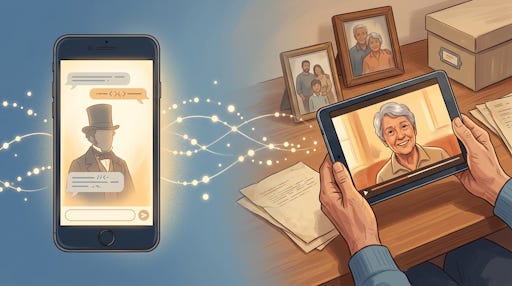
That’s the fun side of AI chat apps.
You can now open an app, choose a famous figure, and start typing. The conversation may be clever, surprising, and occasionally a little silly. Used with the right expectations, it can make an afternoon more interesting and may even send you back to a book or documentary with fresh questions.
The trouble starts when all AI conversations get lumped together. A role-play chat with Napoleon is one thing. A service that claims to let you talk with a deceased parent is something else entirely.
Get everything TheSeniorTechie offers with our Premium membership: monthly Brain Health and AI For Seniors Deep Dives, step‑by‑step Premium Guides, and lifetime TechMaid support (a $50/year service, included at no extra cost). You also won’t see this message.
Which Famous People Can You Chat With?
Historical-figure chat apps give you a menu of people from the past. You select a name, ask a question, and receive a reply written in a style that fits the character.
Hello History is one of the better-known examples. It offers one-on-one chats with AI versions of historical figures, including political leaders, scientists, artists, and philosophers. The app describes the experience as a chance to ask questions of influential people from history.
You may find figures such as:
Cleopatra
Abraham Lincoln
Albert Einstein
Buddha
Marie Curie
Leonardo da Vinci
Winston Churchill
Nikola Tesla
Joan of Arc
Galileo
Humy.ai offers a similar idea for education. It says students can converse with historical figures that use a collection of materials such as letters, speeches, books, and photographs.
That can be more engaging than reading a dry summary. Suppose you ask Frederick Douglass, “What gave you the courage to keep speaking?” The reply may lead you toward a speech, autobiography, or historical event you want to explore further.
A good way to use these apps is to ask questions that bring a subject to life:
“What problem were you trying to solve?”
“Who disagreed with you, and why?”
“What did you get wrong?”
“What would surprise people today about your time?”
“What book, speech, or invention should I study next?”
You might be surprised how much more you remember when history arrives as a conversation rather than a list of dates.
Are The Answers Historically Reliable?
Sometimes. Not always.
These apps do not work like a video archive or a library database. They generate answers based on patterns in the information used to build and guide the character. The result may sound exactly right even when a detail is wrong.
That is not a reason to avoid them. It is a reason to use them with your eyes open.
Think of the chat as a lively tour guide. A good tour guide can point you toward something worth learning. You still want to check the plaques, the documents, and the history book before you repeat a story at dinner.
Have you ever heard a confident speaker explain something that turned out to be wrong? AI can do that too. It does not pause and say, “I’m not entirely sure about that date,” nearly as often as it should.
Try this simple test. Ask the historical character about an event or quotation you already know well. If the answer adds suspicious details, gets the date wrong, or sounds too polished to be believable, keep your conversation light.
For anything you want to cite, verify it with a museum, library, university, or established history source.
What About Fictional Characters And Celebrities?
The options get much broader once you move beyond history.
Character.AI is an interactive entertainment platform where people create and chat with original characters, role-play personas, teachers, coaches, and celebrity-inspired personalities. It has a large collection of characters created by both the platform and its users.
You can find a detective, a fantasy wizard, a tough football coach, a 1930s newspaper editor, or a fictional therapist-like character. You can also build your own character around a hobby, a book club, a travel plan, or a subject you want to learn.
For example, you could create a chat persona called “The Practical Family Archivist.” Give it a clear job: help you list photographs, write captions, organize old documents, and prepare questions for relatives.
That is a useful use of the technology. You are directing an assistant, not confusing a made-up character with an expert you should trust blindly.
Be especially careful with celebrity bots. They may use a recognizable name, photo, or tone, but the conversation is still a computer-generated imitation. It may not reflect what that living person thinks, believes, or would say.
A practical step: avoid sharing personal information, private family stories, financial details, or passwords with public character bots. Treat them like a conversation in a crowded coffee shop, not a private notebook.
Can You Make Your Own Helpful Persona?
Yes, and this may be the most useful part of the whole category.
General AI tools can be instructed to speak as an invented expert or helper. You might create:
A patient technology coach who explains iPhone settings one step at a time
A family-history interviewer who asks you thoughtful questions
A book-club companion who helps you remember what you read
A travel planner who focuses on accessible hotels and short walking distances
A digital-estate-planning coach who helps you make a list of accounts and documents
You do not need to pretend the persona is a real human being. In fact, you get better results when you give it a clear role and plain instructions.
Try writing: “You are a calm family-history interviewer. Ask one question at a time. Wait for my answer. Then ask a follow-up that helps me remember names, places, and dates.”
That turns the tool into a useful prompt for recording your life stories. You remain in charge of what gets remembered.
When Does It Become More Personal?
The emotional stakes change when the person being simulated is someone you loved.
Services in this category may offer a chatbot, voice, image, or video avatar built from a deceased person’s messages, photographs, recordings, and other material. Some generate entirely new replies. Others focus on replaying answers recorded while the person was alive.
How Can You Preserve Real Family Answers?
StoryFile Life lets someone record video answers to guided questions. When a family member asks something later, the service matches the question with a relevant prerecorded response and plays the actual video.
That gives your family something solid: your real voice, your expressions, and your own version of the story.
You might be sitting at the kitchen table, answering a question about your first job. Years later, a granddaughter asks the same question and hears you describe the boss, the pay, the bus ride, and whatever made the day memorable. Nothing has been invented to fill a gap.
Start with a short recording session. Put your phone on a stand, sit near a window, and answer three questions:
What was your childhood home like?
What was a turning point in your life?
What do you hope your family carries forward?
Save the original videos in a folder you control, not only inside one app.
What Should You Protect?
Before you share family recordings, messages, photographs, or voice clips with any service, read its privacy terms. Find out whether the company trains its systems on your material, lets you export your files, and offers a real deletion process.
This matters because services can close. HereAfter AI, which offered voice-based life-story avatars, reportedly announced a shutdown in July 2026. If your only copy sits inside an app, your family may lose access when the service changes or disappears.
There is also a fraud concern. The Federal Trade Commission warns that scammers can use voice-cloning technology to imitate a familiar person and create urgent requests for money.
Use these guardrails:
Get clear permission from a living person before using their voice or personal materials.
Keep original recordings, photographs, and documents in more than one place.
Tell relatives plainly when an answer is AI-generated.
Do not let a chatbot settle legal, financial, medical, or estate questions.
Set a family code word for urgent money requests.
Hang up and verify any alarming call through a number you already know.
Fun historical chats can be a good doorway into learning. Family legacy projects can be even better, because they save the words you truly want your family to hear.
The best result is not a clever imitation. It is a well-kept record that lets your children, grandchildren, and future relatives hear your stories straight from you.
Frequently Asked Questions
Q: Can historical chat apps help with schoolwork or book-club research?
A: Historical chat apps can spark questions and suggest topics, but you should verify important claims with reliable books, libraries, museums, or university sources.
Q: Can you create a private AI character for your own family project?
A: Private AI characters may be useful for organizing questions and notes, but review the service’s privacy settings before adding personal material.
Q: Can a recorded video archive be passed down outside an app?
A: Recorded video files can be copied to personal storage, external drives, and trusted cloud accounts so your family is not dependent on one company.
Q: Can a cloned voice be used to request money from relatives?
A: Cloned voices can be used in impersonation scams, so verify urgent requests independently before sending money or sharing personal information.
What famous person would you enjoy questioning first, and what would you ask?

