

You already know you should move more. You’ve heard it from your doctor. You’ve read it a dozen times. What nobody tells you is which activities won’t wreck your knees, bore you senseless, or make you feel like you’re doing physical therapy in a parking lot.
That gap between “you should exercise” and “here’s something you’ll actually want to do tomorrow” is what this article is here to fill.
Why Does Staying Active Even Matter?
Your body is designed to move. When it doesn’t, things get stiffer, slower, and creakier faster than you’d expect. Regular physical activity for adults over 60 reduces the risk of heart disease, improves balance to prevent falls, sharpens cognition, and does wonders for mood.
The CDC recommends 150 minutes of moderate activity per week for older adults. That sounds like a lot until you break it down: about 20 minutes a day. A brisk walk. A swim. A few games of pickleball. Suddenly it’s doable.
Actionable step: Pick one activity from this list and put it on your calendar for this week. Not “someday.” This week.
Keep your brain sharp with monthly Brain Health and AI For Seniors Deep Dives, and premium tech guides by becoming a Premium subscriber. TechMaid 24/7 tech support (a $50/year value) included.
Is Pickleball Really That Good?
Yes. And I say that as someone who was skeptical until about two years ago.
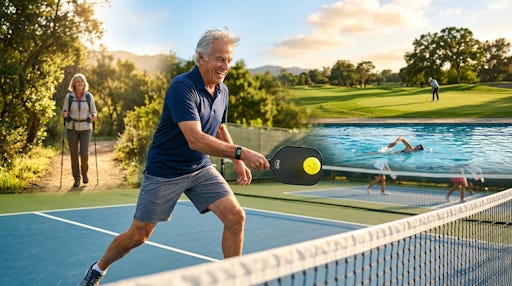
Pickleball is played on a smaller court than tennis, uses a paddle and a plastic ball, and involves an underhand serve that’s easy on shoulders. The smaller court means less running. Less running means less pounding on knees and hips. Doctors report that patients who’ve had hip or knee replacements can often return to pickleball faster than to other sports.
There’s also a brain component. The game requires quick decisions, hand-eye coordination, and reading your opponent. That kind of mental engagement may help reduce the risk of cognitive decline.
And honestly? It’s fun. People laugh. They talk. They come back.
What If You Actually Want to Get Better?
Most people hit a wall with pickleball. They play. They practice. They don’t seem to improve. That’s frustrating, and it’s usually because they’re repeating the same habits without any structured skill-building.
That’s exactly what Bob Savar’s Substack newsletter, Elevate Your Pickleball Game, is designed to fix. Bob is a certified pickleball instructor who publishes a new skill breakdown every week. One skill. Drills. Common mistake patterns. A clear path forward.
Readers describe his approach as “laying one brick at a time” to build a strong foundation. If you’re playing at a 3.0 to 4.0 level and wondering why you’re stuck, this newsletter is worth bookmarking.
Actionable step: Subscribe to Bob’s Substack and read one issue before your next session.
Can Technology Actually Help Here?
This is where it gets interesting. You don’t need to be a tech enthusiast to benefit from a few smart tools. Some of these are genuinely useful, not just gimmicks.
Start with a fitness tracker. The Fitbit Charge 6 (under $200) monitors heart rate, tracks steps, and has built-in GPS for outdoor walks and hikes. The Apple Watch SE (~$239) adds fall detection and works beautifully if you’re already using an iPhone. The Garmin Venu Sq 2 is better for serious outdoor use like hiking and trail walking, with GPS accuracy and up to 11 days of battery life.
These aren’t just step counters. They give you real data about how your body is performing, and that data can be motivating in a way that vague intentions aren’t.
What About Apps for Pickleball Specifically?
A few apps have become genuinely useful for pickleball players who want to improve or find games:
PB Vision: Records your games so you can watch what you’re actually doing, not what you think you’re doing. Great for spotting patterns in your mistakes.
OnForm: Records and reviews your swing or footwork in slow motion. Your instructor (or Bob Savar’s weekly breakdown) becomes twice as useful when you can see exactly what’s happening.
Pickleheads: Finds games, manages sign-ups, handles waitlists, and connects you with local players. Think of it as a social calendar built entirely around pickleball.
None of these requires technical expertise. If you can use your phone to check email, you can use any of them.
What Other Sports Are Worth Your Time?
Pickleball isn’t the only option. Here are some solid choices for staying active outdoors that won’t leave you sidelined for a week:
Walking and hiking: The easiest entry point. You can start slow, build distance gradually, and take in some genuinely beautiful scenery. Asheville locals have some of the best trails in the country, but your neighborhood works fine, too.
Swimming and water aerobics: Near-zero impact on joints. Great for anyone managing arthritis or recovering from surgery. Many community pools offer senior-specific classes.
Golf: Good for hand-eye coordination and a decent cardio workout if you walk the course. It’s also very social, which matters more than people admit.
Bocce ball and lawn bowling: Easy on the body, genuinely competitive, and you can play them in a park with almost no equipment.
Tai chi and outdoor yoga: These aren’t just stretching. Both improve balance significantly, which is one of the top factors in preventing falls for adults over 65.
Bird-watching: Not a sport in the traditional sense, but it gets you walking, it sharpens focus, and research shows it reduces stress and lowers blood pressure.
How Do You Avoid Hurting Yourself?
That’s the real question, isn’t it? You want to stay active, not end up on the injured list.
A few things that actually work:
Warm up before play. Even five minutes of light movement changes how your body responds to sudden exertion.
Start at lower intensity. Your ego may want to keep up with the 58-year-old across the net, but your rotator cuff will disagree.
Cross-train. Don’t just do one thing. Mix in swimming or walking with your pickleball to avoid overuse injuries.
Listen to your body. Sharp pain is a stop sign. Fatigue is normal. Know the difference.
Talk to your doctor first if you’ve had any recent joint surgery or cardiovascular issues. This is genuinely important, not just legal boilerplate.
Where Do You Find Other Players?
The social piece is huge. People who exercise with others stick with it longer. And walking onto a court by yourself is intimidating the first time.
Find courts near you using the USA Pickleball Place2Play court locator. Many YMCAs, community centers, and senior centers now host open play sessions specifically for beginners.
For broader activity resources and staying safe while being active, the National Institute on Aging at the NIH publishes solid, free guides on exercise for older adults.
Frequently Asked Questions
Q: Is pickleball safe for seniors with arthritis?
A: Pickleball is considered one of the most joint-friendly sports available. The smaller court, underhand serve, and lower intensity reduce stress on knees, hips, and shoulders. Many players with arthritis report they can participate comfortably.
Q: How do I find pickleball courts near me?
A: Use the USA Pickleball Place2Play locator at usapickleball.org to search courts by zip code. Most parks, YMCAs, and senior centers are adding courts rapidly.
Q: Do I need to be athletic to start pickleball?
A: No prior athletic experience is required. The game is specifically suited for players of all fitness levels, and beginners can participate in open play sessions right away.
Q: What’s the difference between recreational and competitive pickleball?
A: Recreational play is casual, social, and focused on fun. Competitive play involves rankings (like 3.0, 4.0 skill ratings) and tournaments. Bob Savar’s newsletter is specifically built for players who want to move from recreational to competitive.
What sport did you play earlier in life, and does it still feel like a realistic option for you now?


This article makes a solid point about staying active, and pickleball fits that better than most people realize. I see it every day — players in their 60s and 70s can move, compete, and enjoy themselves without beating up their joints. And the part about wanting to improve is real. Most people repeat the same patterns for years. Once they start working on one specific skill at a time, their game becomes more predictable and they stop scrambling on every point. It’s one of the reasons I teach the way I do: one skill, one focus, real progress.