

Why your health questions now often get an AI answer first
Have you noticed how different Google feels when you type a health question? Instead of a simple list of websites, you often see a chunky box at the top with a neat summary. That’s Google’s Gemini AI at work. It’s not just “search results” anymore; it’s a chatbot embedded right into the page.
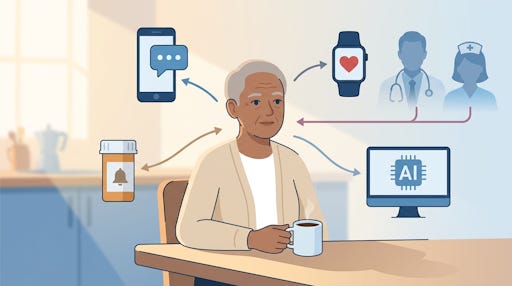
When you ask “knee pain at night” or “side effects of my new pill,” Google may show an AI-written overview before you even see links from a hospital, university, or government site. Sometimes that summary is helpful. Other times, investigations have shown those AI health answers can be inaccurate or contradict official guidance, and Google has had to pull them back on some medical queries.
So even if you never install a chatbot app, you’re already using one whenever you search about your health. The trick now is not “should I use AI?” but “how do I treat AI as a tool, not a doctor?”
Action step:
Next time you search a health question and see that big summary at the top, read it, then scroll down and click at least one real source—ideally from a hospital, university, or .gov site—before you change anything about your care.
Get everything TheSeniorTechie offers with our Premium membership: monthly Brain Health and AI For Seniors Deep Dives, step‑by‑step Premium Guides, and lifetime TechMaid support (a $50/year service, included at no extra cost).
What can chatbots realistically do for your health?
Let’s ignore the hype and talk about the jobs chatbots actually do well. Whether it’s that Gemini summary in Google, the little helper in your patient portal, or a chatbot on your phone, they’re generally good at:
Explaining jargon
You can paste in something like “elevated A1C with peripheral neuropathy” and ask, “Explain this like I’m 75 and not a doctor.” The bot can turn that into plain language you can understand and discuss.
Organizing your story
You might say, “I started a new pill two weeks ago and feel off,” and ask the chatbot to turn that into a dated, clear note you can bring to your doctor: when you started, what changed, what you’ve already tried. It doesn’t know whether you should be worried, but it can help you say what’s going on.
Supporting routines and reminders
Wearables and apps use AI to nudge you about meds, track steps and sleep, and produce simple charts. If you’re trying to keep blood pressure under control, having a clean history of readings and pills taken can make those quick office visits far more useful.
Untangling health portals
Have you ever opened your patient portal and had no idea where to click? Many health systems now use chatbots to answer “Show my upcoming appointments,” “Refill this prescription,” or “Download my visit summary,” without dragging you through six screens.
Scenario:
You get a lab letter full of numbers. You paste the main paragraph into a chatbot and ask it to rewrite the explanation in everyday English. You bring that version along and tell your doctor, “This is how I understand it now—did I get it right?” The chatbot helps you understand; your doctor still decides what happens next.
Where do chatbots go wrong for seniors?
This is where your skepticism pays off.
Chatbots can sound calm and confident while being wrong. They don’t see your full chart. They’re guessing based on general information and patterns in text. That works for “what is A1C,” but not for “do I need the ER tonight?” The same issue shows up in AI health summaries in search: nice tone, limited understanding of your situation.
Regulation is another problem. Most consumer health chatbots and search summaries aren’t treated like medical devices. They haven’t gone through the kind of testing your pacemaker did. When they give bad advice, you might see an update down the road, but you feel the consequences right away.
Privacy is messy, too. Some tools run inside your health system and are covered by medical privacy laws. Many others live on general websites or apps and are not. If you hand them your full name, address, diagnoses, and insurance details, that information may be stored and used to “improve” the system, with no doctor watching how it’s used.
And there’s a human cost. A study on older adults found they tend to use chatbots mainly as a bridge to a human, not as a replacement; they want the bot to help them reach a person, while younger adults often use bots to avoid people altogether. If clinics lean too hard on chatbots and make it harder to reach nurses and staff, older patients can feel shut out.
Scenario:
You feel chest pressure and short of breath. Instead of calling the nurse line or 911, you type it into a chatbot. It says, “Probably anxiety, try breathing exercises.” You decide not to call anyone. That’s exactly the kind of situation where a bot should never get the final say.
Action step:
Write this where you’ll see it: “Chest pain, trouble breathing, sudden confusion, or weakness: I call a clinician or 911. I do NOT ask a chatbot first.”
How can you use chatbots without handing them the steering wheel?
The safest way to live with all this AI is to give every tool clear limits.
Use chatbots to learn, not to decide
Treat them like very patient librarians or translators. They can explain words, summarize instructions, and help you organize questions. They should not be the ones telling you whether a symptom is serious or picking a treatment plan. If their answer would change your meds, delay urgent care, or start something new, that’s a sign you need a human in the loop.
Let health-system bots handle bureaucracy
The chatbot in your clinic’s portal is there for refills, scheduling, directions, and downloading records. Let it do that boring work. If it starts telling you how worried to be about new symptoms, take that as a suggestion to talk to a nurse, not a final verdict.
Use reminders and logs, keep decisions human
Medication reminder apps and wearables are great at tracking when you took your pills, what your blood pressure numbers look like over time, and how much you’re moving. Show those logs to your doctor. But don’t let an app “optimize” your regimen by changing doses on its own, no matter how clever it claims to be.
Watch emotional dependence
If an AI companion or chatbot makes long afternoons less lonely, that’s fine. Just notice if you start talking more to the device than to any friend or family member. Loneliness is real, and bots can help around the edges, but they shouldn’t quietly replace human relationships.
Action step:
For each AI thing you already use, even if it’s “just Google”, answer three questions on paper:
What job am I hiring this for?
When does a human have to take over?
What information am I not willing to share with it?
Once you’ve written that down, it’s much harder for a chatbot to wander into jobs it shouldn’t have.
One simple way to test a health chatbot this week
Here’s a low-risk trial you can run.
Before your next appointment:
Find the last letter, portal note, or test result explanation from that doctor.
Ask a chatbot to “rewrite this in clear, everyday language for a 75-year-old.”
Bring that version to the visit.
Tell your doctor, “This is how my AI assistant explained your note. Is that accurate?”
You’ll learn quickly whether the chatbot is helping you understand or adding confusion. You’ll also get a sense of how your clinician feels about you using these tools as helpers instead of replacements.
Frequently Asked Questions
Q: Are health chatbots safe for seniors?
A: They’re fine for explanations and organizing your questions, but you should never treat them as a doctor, especially when symptoms are urgent or severe.
Q: Can a chatbot help manage medications?
A: Yes, they’re useful for reminders and logs. Any change in dose or new medication needs to be approved by your doctor or pharmacist.
Q: What should I do with Gemini’s health summaries in Google?
A: Read them as a rough guide, then scroll down and check at least one reliable source before acting on anything they suggest.


This one doesn't have a natural pickleball tie-in, so here's a version with a personal detail worked in instead:
The three-question exercise is the practical piece that stands out, what job am I hiring this for, when does a human take over, what won't I share. Most guides about AI just say "be careful" without giving you an actual test to run, and that one's simple enough people would actually do it.
I use an Oura ring and Apple Watch myself, mostly for sleep and recovery data, and I've had to ask myself that same "what job am I hiring this for" question. It's easy to let a device start making decisions for you instead of just handing you information.
The finding that older adults treat chatbots as a bridge to a person rather than a replacement is the most reassuring part. It pushes back against the assumption that AI tools are really about avoiding people altogether.
No! You're don't get the truth or anything reasonable from Google anymore. We now need to go back to those books published before we knew the drivel would waste our time by giving us nonsense...