

You notice small things first. Dad comes back from the back pasture a little later than expected. Mom takes a wrong turn on a road she’s driven a thousand times. Nobody panics yet. But that quiet worry has started, and you’d feel better if you just knew where they were.
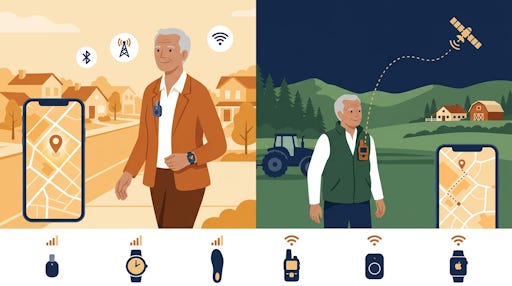
That’s exactly why GPS trackers for seniors have become a real category, not just a gimmick. But the devices that work fine in a suburb fall apart the moment someone drives into a hollow in the mountains or rides an ATV three miles out to check a fence line.
Here’s what’s out there in 2026, what the differences actually mean, and which tools make sense when cell service is a fantasy.
Why Seniors Wear Trackers
Safety is the obvious answer, but the real reason is independence. The goal for most families isn’t surveillance. It’s keeping someone active and autonomous as long as possible while having a quiet safety net in place.
This matters especially for people with mild cognitive impairment (MCI), where memory may be slipping but daily life in familiar territory still runs pretty normally. The tricky part is that functional decline isn’t always obvious right away. Families want to know: did he actually go out to that pasture this morning, or is the tractor just sitting there?
Falls, overturned ATVs, getting disoriented on a familiar route — these aren’t hypotheticals. They happen in the early stages of cognitive decline, and rural workers are especially vulnerable because they often work alone over large areas. Roughly 60% of people with dementia will wander at some point, but the risk in rural settings runs wider than wandering. Think perceptual decline combined with an ATV, a tractor, or a long drive to a distant pasture.
Paid subscribers get full access to all Premium Guides (including our monthly brain health deep dive) plus lifetime tech support from our partner TechMaid (a $50/year value, included for free).
How Most Consumer Trackers Work
Most trackers sold as senior safety devices rely on a combination of cellular, GPS, and Wi-Fi signals. The device grabs a GPS location fix, then uses your cell carrier’s network to send that data to an app. That works well in towns and suburbs. The moment you leave coverage, the device goes silent.
Understanding that fundamental limit is the single most important thing a family can do before buying.
The Jiobit Smart Tag
The Jiobit Smart Tag is a good example of how far the cellular-based category has come. It’s roughly the size of a large matchbook, weighs less than an ounce, and clips discreetly to clothing, a lanyard, a belt loop, or a backpack. Jiobit calls its approach “Progressive Beaconing” — the device automatically connects through whatever signal is strongest at any moment: 5G cellular, GPS, Wi-Fi, or Bluetooth.
Key specs:
Price: $149–$229 depending on bundle
Subscription: $8.33–$16.99/month depending on contract length
Battery life: Up to 168 hours (about 7 days) — real-world results vary by usage
Location update rate: Every 10 seconds in Live View mode
Water resistance: IPX8 rated, shock resistant
Wearing options: Loop, buttonhole clip, hemlock clip, backpack strap
Care Team feature: Multiple family members receive alerts simultaneously
What it can’t do: No SOS button, no two-way voice calling, no satellite fallback. The moment cell service disappears, so does the Jiobit. For suburban and small-town use, it’s genuinely hard to beat. For remote rural work, it’s the wrong tool.
Other Common Cellular-Based Options
For families who want professional monitoring or a watch form factor, here are the devices that consistently rank well going into 2026.
Tranquil GPS Watch is the top-rated overall dementia tracker on SafeWise as of early 2026. It looks like a classic analog watch, which reduces resistance from people who don’t want to feel monitored. Battery lasts up to 7 days, it’s fully waterproof, and the geofencing is reliable. Device cost is $945 and monthly service runs $44.95/month. Steep, but it’s built specifically for this population.
Medical Guardian MGMove Watch offers industry-leading GPS accuracy with a 10-second emergency response time and up to five days of battery life. It comes with professional monitoring built in at approximately $43/month.
AngelSense is built from the ground up for people who resist or remove devices. Non-removable magnetic fasteners keep it in place. It includes a two-way auto-answer speakerphone, routine-based iAlerts, and late departure and arrival alerts — genuinely useful for monitoring whether someone left for the fields and came back. Service plan runs around $45/month.
GPS SmartSole deserves mention as one of the most discreet options in existence. It’s a GPS tracker embedded in a shoe insole. People with dementia are far less likely to remove their shoes than a bracelet or watch, because shoe-wearing is procedural memory — one of the last types retained. The insole sends location updates every 5–10 minutes. Battery lasts 2–3 days and charges in about two hours. It requires cellular service like all others in this category, but the invisibility factor is real and meaningful.
Bay Alarm Medical SOS Smartwatch is a reliable, lower-cost option for budget-conscious families, good for standard tracking and SOS needs.
Apple Watch SE or Series 11 gives tech-comfortable seniors health monitoring plus location sharing, though professional monitoring requires a third-party add-on.
All of these devices share the same core limitation: they need a cell signal to report location in real time.
When Cell Service Doesn’t Exist
This is where most articles stop, and where the real problem begins for rural families.
A rancher working alone in a remote valley in western North Carolina, or across a wide Montana spread, has no use for a device that goes dark the moment he crests a ridge. Reduced processing speed and visual-spatial changes can happen even with normal aging — never mind early cognitive decline. Add an overturned ATV in a distant pasture and a device that can’t send a signal, and that tracker was never really a safety net at all.
For these situations, the technology shifts entirely to satellite.
Garmin inReach: Still the Standard
The Garmin inReach Mini 2 has been the go-to satellite communicator for outdoor safety for several years running, rated the best overall satellite messenger by multiple independent testing outlets in 2025 and 2026. It runs on the Iridium satellite network — truly global coverage, not “near-global”. It weighs 3.5 ounces, sends and receives two-way text messages, activates interactive SOS, and broadcasts a passive breadcrumb trail that authorized family members can follow in real time on Garmin’s MapShare platform.
Key specs:
Price: Around $299–$400
Subscription: Starting at $7.99/month
Battery life: Up to 14 days in 10-minute tracking mode; up to 30 days at 30-minute intervals
SOS: 24/7 interactive — rescuers can text back
Location accuracy: 3 meters
Weight: 3.5 oz
Important for families considering this for someone with cognitive decline: The passive breadcrumb trail runs automatically once activated, without the person doing anything. Family members can check the map anytime to see where Dad went and whether he came back. The SOS button requires the person to activate it manually — you cannot count on that with cognitive decline. The breadcrumb trail is the valuable piece here, not the SOS.
The New Mini 3 and Mini 3 Plus (December 2025)
Garmin released the inReach Mini 3 and Mini 3 Plus in December 2025, and they’re a meaningful upgrade.
Both models add a 1.9-inch color touchscreen display (replacing the tiny monochrome screen on the Mini 2), IP67 water and dust resistance, unlimited waypoints and activity storage, and improved multi-GNSS positioning for faster location fixes.
The Mini 3 Plus adds a microphone and speaker for 30-second two-way voice messages, on-device voice-to-text transcription, and messages up to 1,600 characters. Battery life on both models is rated up to 350 hours (about 14.5 days) in 10-minute tracking mode.
Pricing: Mini 3 at $449.99, Mini 3 Plus at $499.99. Subscriptions start at $7.99/month, same as the Mini 2.
For families tracking a working rancher or farmer remotely, the larger color screen means the person can actually read and interact with the device more easily — a real improvement. The Mini 2 is still available and works well at a lower price point. Either one solves the no-cell-service problem.
Zoleo: The More Affordable Satellite Option
The Zoleo Satellite Communicator runs on the same Iridium network as Garmin and is worth serious consideration, especially for budget-conscious families. Device price is around $149–$200, and plans start at $20/month for 75 messages.
Zoleo’s location sharing feature (tracking visible to authorized contacts) costs an extra $6/month on top of the base plan. The device is screenless — it pairs with a smartphone app for message composition — but it has dedicated SOS and check-in buttons. Its big practical advantages: lower upfront cost, pauseable subscription at $4/month when not needed seasonally, and a dedicated phone number so contacts can message you directly.
The tradeoff versus Garmin: no standalone navigation, heavier reliance on your phone, and slightly slower message transmission.
SPOT Gen4: Simple One-Way Option
The SPOT Gen4 runs on the Globalstar satellite network (not Iridium, so coverage is slightly less extensive in very remote areas) and is the simplest, lowest-cost entry into satellite safety.
Price: $149.99
Subscription: $11.95/month on a 12-month plan
Battery: 4 AAA lithium batteries lasting 78–156 days at 60-minute tracking intervals
Messaging: One-way only — sends location to contacts, cannot receive messages
Motion-activated tracking: Only sends when moving, preserving battery
For families where passive location breadcrumbs are the main goal and interactive communication isn’t a priority, the SPOT Gen4 is significantly cheaper to operate than Garmin. The AAA battery approach is genuinely simpler than a rechargeable device for people who might not remember to plug something in. That’s not a small thing.
ACR Bivy Stick: Good for Group Awareness
The ACR Bivy Stick is worth knowing about if multiple family members or workers need to track each other across a large operation. It runs on the Iridium network, offers SOS monitoring and two-way messaging, and its MESH model adds LoRa technology so devices can communicate directly with each other — without satellite or cell — up to 10 miles in open terrain. Starting price is around $300, with a $20/month base plan.
For a ranch operation where multiple people need to know each other’s locations, the Bivy Stick’s GroupTrack feature is more robust than what Garmin or Zoleo offer for coordinated group tracking.
Personal Locator Beacons: Know the Limit
Personal locator beacons (PLBs) like the ACR ResQLink View use the international Cospas-Sarsat satellite network, require no monthly subscription, and carry a battery life measured in years, not days.
They can only send a single SOS signal. No passive tracking, no breadcrumb map, no two-way communication. A PLB doesn’t answer “did Dad go to the east pasture this morning?” It only answers “Dad pushed the emergency button” — which requires the person to recognize they need help and take action. That’s exactly what you cannot count on with cognitive decline. PLBs are excellent for a healthy, cognitively intact person doing solo backcountry work; less suited to the monitoring scenario described here.
Apple Watch Ultra 3: Worth Noting
The Apple Watch Ultra 3 (released late 2025) now includes Emergency SOS via satellite, free for two years after activation. A tech-comfortable senior with an iPhone 14 or later can contact emergency services and share GPS location even with no cell or Wi-Fi coverage. The watch also has automatic fall detection and crash detection that can trigger satellite SOS without the person doing anything.
For someone in early-stage MCI who is already comfortable with an Apple Watch, this closes a meaningful gap. It’s not a passive breadcrumb tracker — family can’t watch a live map — but fall detection plus satellite SOS is a genuinely useful combination for people still working independently in remote areas.
Putting It Together for Rural Families
No single device solves every part of this problem right now.
For daily passive location tracking where cell service is available, the Jiobit Smart Tag is the strongest choice for discretion and battery life. For urban or suburban use with professional monitoring, the Tranquil GPS Watch or Medical Guardian MGMove cover the full picture. For remote areas without cell service where passive breadcrumb tracking matters most, the Garmin inReach Mini 2 (available, lower price) or the new Mini 3/Mini 3 Plus (better screen, more features) are the clear answer. For remote use where budget is the priority and one-way check-ins are enough, the SPOT Gen4 is simpler and cheaper to operate, especially with its AAA batteries. For group tracking across a large family operation, the ACR Bivy Stick’s MESH capability stands out. For discreet tracking of someone who removes devices, the GPS SmartSole insole is the most invisible option available.
The inReach Mini 2 or Mini 3 remains the strongest all-around tool for rural, off-grid situations because it doesn’t need cell service, the passive breadcrumb map is shareable with family, and the battery is manageable if built into a daily routine — clipped to a work vest or jacket. The Zoleo is worth considering if the upfront cost of Garmin is a barrier.
What these families are trying to do — thread the needle between monitoring and independence — is exactly right. The technology is better than it was even three years ago. It’s just not yet invisible or automatic, and that remains the real gap.

