

You may want to exercise more, yet the equipment you see online often looks made for somebody training for a triathlon. Tiny buttons. Confusing apps. Instructors who pop down to the floor and back up before you’ve found a safe place to put your hands.
You deserve better choices than that.
The good news is that exercise technology for seniors now includes useful tools for walking, seated movement, balance, strength, and even physical therapy at home. The trick is choosing something that fits your body, your house, and your willingness to use it on an ordinary Tuesday morning.
The best product isn’t necessarily the one with the biggest screen or fanciest software. It’s the one you can start safely, understand without a manual the size of a cookbook, and use often enough to make a difference.
Get everything TheSeniorTechie offers with our Premium membership: monthly Brain Health and AI For Seniors Deep Dives, step‑by‑step Premium Guides, and lifetime TechMaid support (a $50/year service, included at no extra cost). You also won’t see this message.
What do you need help with?
Before comparing products, decide what you want help doing. A watch that counts steps will not solve the problem of sore knees on stairs. A smart strength machine may be excessive if you mainly need a safe way to move while watching television.
Ask yourself a few honest questions:
Do you need more daily movement while seated?
Do you want to build leg or upper-body strength?
Are you concerned about balance or a recent loss of confidence?
Would short guided classes help you stay consistent?
Do you need a program connected to your health plan or physical therapist?
The Centers for Disease Control and Prevention recommends that adults 65 and older include aerobic activity, muscle-strengthening activity, and balance work each week. You don’t need to tackle all three on day one. You do need a plan that makes you more likely to keep moving.
Action step: Choose one goal for the next 30 days. “Use a seated pedal machine for ten minutes after lunch” is a better goal than “get in shape.”
Which wearables are worth wearing?
A wearable works best when it answers one useful question: “Did I move today?” It doesn’t need to turn your wrist into a medical laboratory.
If you already use an iPhone, the Apple Watch Series 12 may fit naturally into your routine. It tracks activity and workouts, monitors heart-rate information, and includes Fall Detection and Emergency SOS. It requires an iPhone 11 or later with iOS 27 or later, so it makes little sense if you use Android or don’t want a smartwatch on your wrist.
The Fitbit Charge 6 is simpler and smaller. It tracks steps, distance, heart rate, Active Zone Minutes, and workouts, and it works with both iPhone and Android phones. It may suit you if you want basic fitness tracking without calls, texts, apps, and a great deal of wrist clutter.
The Garmin Venu 4 deserves special attention if you use a wheelchair. Its wheelchair mode counts pushes rather than steps and includes handcycling and push-speed workouts. Garmin says some features, including incident detection and VO2 max estimates, are disabled while this mode is active. That is a fair trade if the tracker reflects how you actually move.
Do you really need a recovery score, sleep score, readiness score, stress score, and another score telling you how you feel? Probably not. Start with steps, walking time, or one guided workout.
Action step: Wear your tracker for one week without changing your routine. Then use the information to set one realistic target, such as 500 more steps a day or three 15-minute walks a week.
Can seated equipment get you moving?
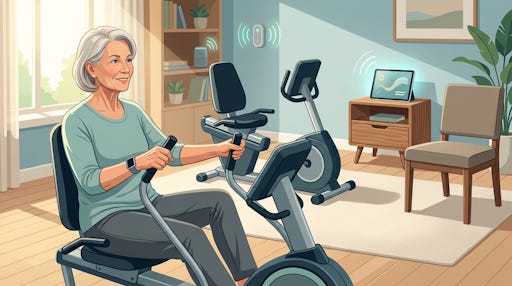
Yes. Seated equipment can be a sensible bridge when standing exercise feels uncomfortable, your balance is shaky, or you want to move while reading or watching a program.
The Cubii Move is a compact seated elliptical with six resistance levels and a basic display. It is meant for gentle lower-body movement while seated. It does not automatically sync workout data with the Cubii app, which may be a relief if you want fewer apps, not more.
The Cubii Total Body adds an upper-body pulley system and 12 resistance levels. It is designed for seated use only. Don’t stand on it, even if you’re tempted to use it as a shortcut to a different workout.
If you want a more conventional cardio machine, consider the Sunny Smart Programmable Recumbent Bike. It has a wide seat, mesh back support, 16 resistance levels, built-in programs, and Bluetooth connection to the SunnyFit app. Its step-through frame may be easier to enter than an upright exercise bike. Still, check the listed inseam range and 300-pound weight limit before ordering.
For a more substantial machine, the NuStep T4r is a recumbent cross trainer with a low step-through design, swivel seat, stable pedals, grab ring, and user-controlled step length. It is often seen in rehabilitation and senior-living settings for good reason: getting on and off is part of the exercise experience, and this machine gives that process serious thought.
The Theracycle-R is more specialized. Its motor-assisted pedals can support upper- and lower-body movement for someone who cannot comfortably power a standard machine. It includes a swivel seat and a quick-stop safety feature. This is the sort of purchase to discuss with a physical therapist if mobility or neurological issues are part of the picture.
Action step: Before buying a large cardio machine, practice sitting down and standing up from a dining chair several times. If that movement is difficult or painful, prioritize a machine with a low entry and stable handholds.
Could an app keep you consistent?
For many older adults, the right app is more useful than another piece of equipment. A short class you follow three times a week can beat an expensive machine you avoid.
SilverSneakers GO is worth checking first if you have Medicare coverage. The app offers adjustable workouts, guided videos, activity scheduling, progress tracking, and a search tool for fitness locations. Access depends on whether your Medicare plan includes SilverSneakers.
Bold is designed for adults 65 and older. Its programs include strength, balance, mobility, and pain-management classes, with live and on-demand options. Some Medicare and health-plan partners provide access without an added charge.
Mighty Health targets adults 50 and older with chair workouts, stretching, yoga, aerobics, coaching, nutrition support, and habit tracking. It may connect with Apple Health, though coverage can depend on your health plan.
If balance is your main concern, Nymbl Balance is particularly interesting. It combines short physical exercises with cognitive games, and it can be used standing or seated. Access comes through certain partner organizations, not through unrestricted direct purchase.
Have you ever started a video workout and quit because the instructor moved too fast? Don’t blame yourself. The class was a poor fit. Look for programs that offer clear modifications, calm pacing, seated choices, and rest breaks you control.
Action step: Check your Medicare Advantage plan, supplemental benefits, employer retirement benefits, or health-plan website before paying for a fitness app. You may already have access.
When does virtual therapy make sense?
An app is not the same as physical therapy. But some digital-care services provide structured exercises and professional oversight that may help with back pain, knee pain, arthritis, or recovery after a musculoskeletal problem.
Hinge Health offers personalized exercise therapy, a care team, and 3D motion tracking that provides movement feedback. Sword Thrive combines guided sessions, computer-vision movement tracking, and oversight from a Doctor of Physical Therapy. Kaia Health provides 10-to-15-minute exercise sessions for muscle and joint issues, along with health-coach access.
These services generally come through an employer, health plan, or other partner organization. They are not always available as a straightforward retail subscription.
If you have pain that changes how you walk, trouble getting up from a chair, or a new fear of falling, this category may be more useful than a generic exercise app. A professional can help you decide whether a movement should be adjusted or avoided.
The National Institute on Aging advises older adults with chronic conditions to discuss how their health affects physical activity and to build up gradually. That’s sensible advice, not a sign that you should sit still.
Action step: Call the member-services number on your insurance card and ask specifically about virtual physical therapy, musculoskeletal care, and fall-prevention benefits.
Are treadmills and VR worth it?
They can be, but this is where good judgment matters more than novelty.
The Egofit Walker Plus-M1T is a compact treadmill with a folding handrail, remote control, and app connection. The handrail makes it more promising than a rail-free walking pad. You still need enough balance, adequate lighting, clear floor space, and the habit of using the safety feature.
The Horizon T101 Connect is a full-size folding treadmill with a cushioned 20-by-55-inch deck, large accessible speed and incline controls, six built-in programs, Bluetooth support, and a 300-pound weight limit. Its larger walking surface and more substantial structure may suit you better than a compact pad, assuming you have the room.
Interactive fitness can also be social. Nintendo Switch Sports includes bowling, golf, tennis, badminton, volleyball, soccer, basketball, and swordplay. Bowling or golf may be enjoyable ways to get up and move with family. Clear the floor first, use the wrist strap, and skip movements that make you unsteady.
Virtual reality deserves more caution. Supernatural and FitXR offer coached fitness through Meta Quest headsets. They can be engaging, but they also block your view of the room. If your balance is uncertain, you take medications that cause dizziness, or you need a stable visual reference, a headset workout may not be the wisest place to start.
Action step: For any treadmill or VR workout, have another person nearby for your first session. That is not being timid. It is a sensible test run.
Can smart strength systems help?
Smart strength equipment can track your progress and change resistance automatically. It can also cost a good bit, require installation, and ask you to manage cables, screens, attachments, and subscriptions.
The Peloton Guide connects to your television and uses a camera to show you beside an instructor. It tracks whether you are performing prompted movements and keeps track of recently worked muscle groups. Peloton says clearly that its Movement Tracker does not count repetitions or correct your form. That distinction matters.
The Tonal 2 is a wall-mounted cable machine with electromagnetic resistance that starts at five pounds and changes in one-pound increments. That precision may appeal if you are steadily building strength. Yet you must consider the installation, cost, required membership, wall location, and whether you can safely manage cable exercises.
The Vitruvian Trainer+ uses a floor platform and resistance that adapts as you exercise. It can store under some beds or couches, but compact storage doesn’t remove the need for clear setup space and safe attachment use.
Strength training should leave you feeling worked, not frightened or wobbly. If a machine gives you a choice between a simple movement you understand and a complicated exercise that makes you nervous, choose the simple movement.
Frequently Asked Questions
Q: Which exercise technology is easiest to start with?
A: A seated pedal machine or a basic fitness tracker is often easiest because you can begin with short sessions and learn one function at a time.
Q: Can I use a treadmill if I have balance problems?
A: Maybe, but discuss it with a clinician or physical therapist first and choose a model with sturdy handrails, a safety key, slow starting speeds, and clear space around it.
Q: Are Medicare fitness benefits the same with every plan?
A: No, fitness-app and gym benefits vary by plan, location, and year, so confirm coverage directly with your insurer before you enroll or pay.
Q: Is virtual reality exercise safe for older adults?
A: Sometimes, but it requires good balance, clear floor space, comfort with a headset, and the ability to move without seeing the physical room clearly.
Q: Do smart strength machines replace a trainer or therapist?
A: No, smart equipment can guide and record workouts, but it cannot fully assess pain, correct every movement problem, or replace clinical advice.

