

Roughly 96% of older adults with diabetes have type 2. That’s the focus here, because advice about “diabetes technology” gets confusing when it treats everyone’s needs as identical.
The starting point isn’t which device looks impressive. If you’re wondering whether you need a glucose monitor, start with three questions: whether you use insulin, what your treatment requires, and whether your current approach still fits.
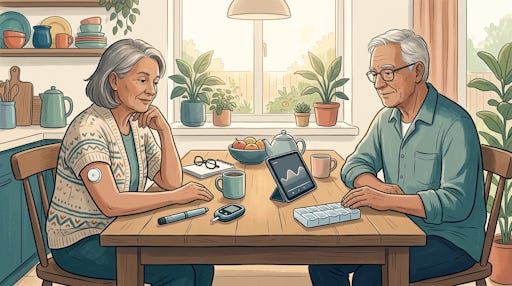
You might take insulin, manage diabetes with other medicines, or follow a plan without medication. You might check glucose frequently, wear a sensor, or rely on scheduled laboratory tests.
November is National Diabetes Month. Rather than another lecture about food, let’s examine what technology might actually do for you.
Part One: Do You Need a Glucose Monitor If You Use Insulin?
When you use insulin, glucose monitoring helps you and your care team manage treatment safely. Too much insulin for your current needs can cause dangerously low blood sugar.
Finger-stick meters remain useful. Continuous glucose monitors, or CGMs, add something different: repeated readings throughout the day and night, including when you aren’t checking.
Certain systems can warn you when glucose drops too low. That matters if lows happen overnight or you don’t reliably feel the warning symptoms.
Do you ever wonder what happens between your usual checks?
The American Diabetes Association’s 2026 guidance recommends CGM for older adults with type 2 diabetes who use insulin to improve glucose outcomes and reduce low blood sugar.
That makes a conversation worthwhile even if you’ve managed with a meter for years. It doesn’t mean you’ve been doing anything wrong.
Your doctor or care team should consider your preferences, ability to use the equipment, available support, and costs. Ask for a demonstration before deciding.
If you already use a CGM, reviewing its reports may help more than buying anything new. Ask which patterns matter and what actions you should take.
Live by yourself? ElliQ by Intuition Robotics is an AI companion robot for older adults, designed to promote social connectedness while serving as a home care hub. By anticipating your needs, ElliQ proactively initiates personalized conversations, learns and remembers, and collaborates with you and your care team to achieve your health and wellness goals. $100 discount with code TheSeniorTechie.
Could Technology Reduce The Daily Work?
Your A1C shows your average blood sugar over roughly three months. A CGM can reveal variation that an average hides, including periods of low glucose.
Here’s a detail that surprises many people: a CGM estimates glucose in fluid between your cells, rather than directly measuring blood. Readings can differ from a finger stick, particularly during rapid changes.
Ask when your particular system requires finger-stick confirmation. Don’t assume you’ll never need your meter again.
Technology may also help with insulin delivery. Connected insulin pens can record dosing information. Automated insulin delivery systems combine a compatible glucose sensor and pump to adjust insulin delivery.
These options aren’t necessary for everyone. Consider them when they could improve safety or reduce a genuine burden.
Have you ever struggled to remember whether you already took a dose? Tell your clinician. That’s a practical problem to address, not something to feel embarrassed about.
Try this review conversation:
“I’ve followed this insulin routine for quite a while. Is it still the safest and simplest plan for me? Would a CGM, different delivery device, or simpler schedule help?”
Don’t change your doses or schedule without an agreed plan.
Ready for the full TheSeniorTechie treatment? Our Premium members enjoy monthly Brain Health and AI For Seniors Deep Dives, all Premium Guides, and lifetime TechMaid tech support—a $50/year service included with membership. You also won’t see this message.
Part Two: Do You Need a Glucose Monitor If You Don’t Use Insulin?
Without insulin, the need for glucose monitoring varies considerably. Your medication, symptoms, treatment results, and risk of low blood sugar all matter.
Some medicines, including sulfonylureas, can cause lows. Not taking insulin doesn’t automatically remove that concern.
Other treatments have a low risk of causing hypoglycemia (low blood sugar) on their own. If your type 2 diabetes is stable, routine daily finger sticks may provide little additional benefit.
Your doctor may reasonably follow your condition through laboratory testing and appointments. If that’s your agreed plan, not wearing a sensor doesn’t mean you’re missing essential care.
Conversely, some people who don’t use insulin can benefit from CGM. Additional information may help when glucose remains outside your target, symptoms need investigating, or low readings create concern.
A new study is worth knowing about. In October 2026, the New England Journal of Medicine published a trial of 283 adults with type 2 diabetes who didn’t use insulin. About half were randomly assigned to use a CGM for 26 weeks, and the rest received routine care. The CGM group’s A1C fell about 0.9 percentage points more than the routine-care group’s.
Keep the limits in mind. The study lasted only 26 weeks, and Dexcom, a CGM maker, funded it. It also doesn’t show that everyone who doesn’t use insulin would benefit. The authors suggest that people in this group talk with their primary care provider about using a CGM.
Would extra measurements change anything you or your clinician would do?
Sometimes a short CGM trial or a planned series of finger sticks can answer a specific question. You might not need continuous monitoring indefinitely.
Ask what you’re investigating, how long you’ll collect readings, and who will review them.
If you already test regularly, ask whether your schedule remains useful. If you don’t, ask what circumstances would make home testing appropriate.
What Technology Helps Beyond Glucose Testing?
Useful diabetes technology doesn’t always attach to your body.
A medication reminder may help with a dose you occasionally forget. A phone note can collect questions between appointments. Your patient portal may provide laboratory results and a way to ask nonurgent questions.
Suppose you notice an unexpected reading after breakfast. Record the circumstances rather than immediately deciding your usual breakfast must disappear forever.
One number doesn’t explain everything.
If you have prediabetes, a wearable sensor isn’t an automatic requirement. Technology-supported prevention programs may offer more practical help.
CDC-recognized diabetes prevention programs include online options. They offer structured support without requiring you to drive to every session.
Explore the CDC’s lifestyle change program information. For a consumer account of wearing a sensor, WIRED’s glucose monitor review offers one reporter’s experience, not a medical recommendation.
At your next appointment, ask:
“Does my monitoring plan still fit my medicines and results? Would additional readings help us make a decision, or would another kind of support help more?”
Should You Review Your Longtime Diabetes Routine?
Yes. A longstanding plan deserves periodic review, even when the decision is to keep it.
Years without a change don’t prove your treatment is outdated. They also don’t prove it remains your best option.
Your health, kidney function, appetite, vision, dexterity, and available help can change. Your appropriate glucose targets may change, too.
Ask your clinician to review:
Whether your targets still suit your health.
Whether any medicine creates unnecessary low-glucose risk.
Whether your monitoring provides useful information.
Whether technology could reduce difficulty rather than add it.
Bring your equipment, medication list, and questions. If you collect readings, bring those too.
What part of your current diabetes routine would you most like your doctor to review?
Frequently Asked Questions
Q: Does Medicare cover a continuous glucose monitor (CGM)?
A: CGM coverage may be available for eligible people with diabetes who use insulin or have a history of problematic hypoglycemia (problems with low blood sugar). Your clinician must establish eligibility and prescribe the equipment. Ask the supplier about your expected costs before ordering.
Q: Can you use a continuous glucose monitor (CGM) without a smartphone?
A: CGM systems sometimes offer a separate handheld receiver. Ask about the specific model before ordering, because options differ.
Q: Can a smartwatch measure blood sugar without a separate sensor?
A: Glucose readings displayed on a watch can come from a separate, authorized sensor. The FDA warns against watches and rings claiming to measure glucose independently without piercing your skin.
Q: Can a home glucose monitor diagnose diabetes?
A: Glucose monitors don’t replace the laboratory testing and clinical assessment used to diagnose diabetes. Bring unexpected readings to your clinician rather than diagnosing yourself through an app.

