

Getting out of the shower used to take thirty seconds. Now it’s a production involving a grab bar, a moment of steadying yourself, and maybe a little prayer that the bath mat doesn’t slide. Sound familiar?
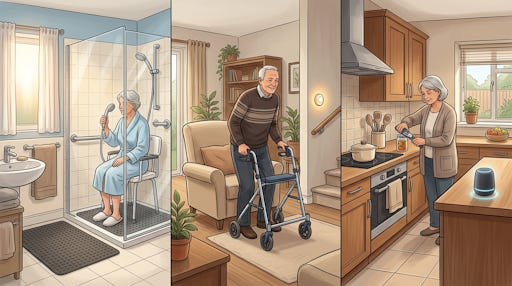
Doctors have a clinical name for the stuff you do every single day without thinking twice: activities of daily living, or ADLs. Bathing, dressing, eating, moving from a chair to standing, using the bathroom, basic hygiene. Six tasks. That’s it. But when even one of them starts to feel like a chore instead of a reflex, everything else in your day gets harder too.
Stay confident with your tech, and keep your mind sharp. Premium subscribers get every Premium Guide, exclusive Brain Health and AI For Seniors Deep Dives, and full access to TechMaid for lifetime tech support (normally $50/year—yours free).
What Exactly Counts As An ADL?
Cleveland Clinic breaks daily living into six core tasks: bathing, dressing, eating, transferring (getting in and out of a bed or chair), toileting, and continence. There’s also a second tier called instrumental activities of daily living, or IADLs, which cover things like managing money, cooking, and driving.
Here’s the difference: basic ADLs are about self-care. IADLs are about running your life. Losing ground on an IADL, forgetting to pay a bill or struggling to follow a recipe, often shows up before trouble with a basic ADL does. That order matters because it gives you a warning window.
More than one in five adults over 85 needs help with at least one basic ADL. That’s not a small number, and it’s not a sign of failure. It’s just where the road leads for a lot of people, sooner or later.
Why Does Losing Independence Feel So Personal?
Because it is personal. Dressing yourself isn’t just about covering your body; it’s about choosing how you present yourself to the world. A physical therapist who works with older adults put it well: helping someone bathe isn’t about the water; it’s about safety and dignity working together, not against each other.
Have you ever noticed how much harder it feels to accept help with something private, like bathing, than with something practical, like yard work? That’s not weakness. That’s you protecting a sense of self that’s been yours for seven or eight decades. Any solution that ignores that reaction is going to fail, no matter how clever the gadget.
Where Does Trouble Usually Start First?
Trouble rarely starts with the dramatic stuff. It starts small.
Meal prep gets skipped because standing at the counter for twenty minutes hurts.
Dressing takes twice as long because buttons and zippers fight back against stiff fingers.
Getting up from a low chair requires a plan, not just a decision.
The bathroom becomes the room you think about before you need to use it.
Notice a pattern? Every one of these is fixable with a tool, a routine change, or a small home modification. None of them requires giving up your home or your schedule.
What Can You Actually Do About The Bathroom?
The bathroom causes more falls than almost any other room in the house, and it’s usually the first place families start making changes. A grab bar near the shower and toilet costs less than a dinner out and takes an hour to install. A shower chair removes the standing-and-balancing problem entirely. Non-slip mats, the kind with actual suction, not the flat rubber ones that curl up at the edges, solve half the danger on their own.
If installing anything yourself sounds like a headache, plenty of home-modification contractors specialize in exactly this and can do the whole bathroom in a day. Ask your local Area Agency on Aging for referrals if you’re not sure where to start.
Can Technology Actually Help With Bathing And Dressing?
Somewhat, yes, though it’s more about the room around you than the task itself. Motion-sensor lighting in the bathroom and hallway means you’re never fumbling for a switch at 2 a.m., which is when a surprising number of falls happen. Wall-mounted radar sensors, the kind used by systems like SafelyYou, can detect a fall without a camera in the room, so privacy stays intact while help still gets called.
For dressing, the fixes tend to be lower-tech and honestly more useful: shirts with magnetic closures instead of buttons, slip-on shoes with elastic laces, a reaching tool for socks. Technology’s real contribution here is indirect. It buys you time and safety so the basic task stays yours to do.
What About Getting Up And Moving Around?
Mobility problems sneak up because they’re gradual. One day getting out of the recliner takes a little grunt. A few months later it takes two tries and a hand on the armrest.
A few practical steps worth taking before things get harder:
Raise the height of low furniture with risers, or replace it, so standing up doesn’t require leverage you don’t have.
Install a second handrail on any staircase that only has one.
Try a rollator (a walker with wheels and a seat) even if you don’t think you need one yet. Learning to use one before a crisis beats learning during one.
Ask your doctor about a physical therapy referral focused specifically on balance and transfers, not just general strength.
Smart walkers exist now with sensors that adjust speed and brake automatically to prevent tipping, and some even include GPS in case someone gets disoriented. They’re not cheap, but for someone with real balance concerns, worth a conversation with a physical therapist about whether one makes sense.
Is Meal Prep Really Worth Worrying About?
More than you’d guess. Skipping meals or eating the same three easy things on repeat because cooking feels like too much work is one of the quieter ways health slips. It doesn’t look like an emergency. It looks like just getting by.
A few fixes that don’t require becoming a different person:
Meal delivery services like Meals on Wheels aren’t just food, they’re also a daily check-in from another human being, which matters more than people expect.
Adaptive kitchen tools, jar openers with better grip, one-handed cutting boards, lightweight pots, remove the physical barrier without changing what you’re cooking.
A voice assistant set up with a simple routine (”remind me to eat lunch at noon”) solves the problem of losing track of time, which happens to almost everyone eventually.
Batch cooking on a good day, then freezing portions, means a bad day doesn’t have to mean an empty stomach.
Have you thought about who notices if you skip a meal? If the answer is nobody, that’s worth changing before it becomes a bigger problem.
When Should You Bring In Outside Help?
There’s no perfect trigger moment. But a few signs are reliable enough to act on: skipped meals becoming a pattern rather than an occasional thing, bruises from falls you don’t remember happening, clothes that stay dirty longer than they should, or a bathroom you’ve started avoiding.
None of those mean it’s time to give up the house. They mean it’s time for a conversation, with a doctor, with family, or with a home-care agency, about what kind of help actually fits the gap. Sometimes that’s a few hours a week of in-home assistance. Sometimes it’s just better equipment. Rarely is it an all-or-nothing decision.
What’s One Thing You Can Do This Week?
Pick the one ADL or IADL that’s been quietly bothering you, the one you’ve been working around instead of solving. Then take one concrete step: order the grab bar, call about a meal delivery trial, ask your doctor for that PT referral. Small, specific action beats a vague resolution to “make things easier” every time.
For a deeper look at home safety devices, the AARP’s guide to aging-in-place technology at aarp.org walks through options by budget and need. And if you want a starting point on avoiding scams tied to “senior tech” purchases, the FBI’s Internet Crime Complaint Center at ic3.gov is worth bookmarking before you buy anything from an unfamiliar company. On the tech-support side, Apple’s own accessibility guide at support.apple.com covers voice control, magnification, and reminder features already built into an iPhone or iPad, no extra purchase required.
Frequently Asked Questions
Q: What’s the difference between an ADL and an IADL?
A: ADLs are basic self-care tasks like bathing and dressing, while IADLs are more complex tasks like managing money or cooking that require higher-level thinking.
Q: Do I need a doctor’s referral to get a home safety assessment?
A: Not necessarily. Many Area Agencies on Aging and occupational therapists offer home safety evaluations without a formal referral, though insurance coverage for OT visits usually does require one.
Q: Are smart home devices really worth the cost for one person living alone?
A: Worth it depends on the specific risk you’re addressing; a single motion-sensor light or fall-detection pendant can be inexpensive and solve a real, specific danger without a big investment.
Q: How do I bring up the topic of help with daily tasks without offending a parent or spouse?
A: Frame it around a specific incident or task rather than a general decline, and ask what would make that one thing easier rather than proposing a big lifestyle change.


Non slip rubber mats in the bathroom (and in the tub) are a cheap way of making the bathroom a safer place for old folks. Most can be cleaned with a paper towel and spray cleaner. Just be sure to keep the edges flat to the floor to avoid tripping.