

You know that feeling of sitting at a kitchen table with a pill organizer, reading glasses, and three bottles that all look the same? Maybe it’s your own table. Maybe it’s your mother’s, and you’re squinting at labels on a Sunday visit, trying to figure out if she’s already taken her blood pressure pill.
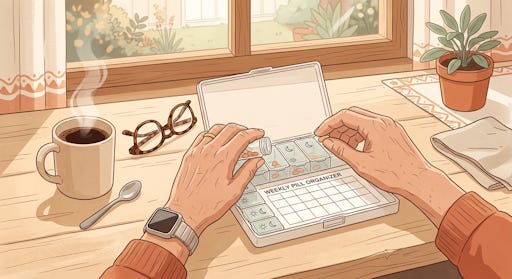
Either way, that moment of doubt isn’t carelessness. It’s what happens when someone is managing more than most doctors realize. If you’re over 65, there’s a 93% chance you have at least one chronic condition, and better than three in four are juggling two or more, according to the National Council on Aging. If you’re caring for a parent, spouse, or older friend, those same odds apply to them.
Complicated systems fail at the handoff points. Health is a complicated system, whether you’re managing your own or watching over someone else’s. The handoffs are where a pill gets skipped, a symptom gets brushed off, or a doctor’s instruction gets misheard on the way out the door. That’s where you actually have control, no matter which side of the caregiving relationship you’re on.
Ready for the full TheSeniorTechie treatment? Our Premium members enjoy monthly Brain Health and AI For Seniors Deep Dives, all Premium Guides, and lifetime TechMaid tech support—a $50/year service included with membership.
Why Does Managing Multiple Conditions Feel So Hard?
Adults over 65 with multiple chronic conditions average five diagnoses and seven different medications, according to research published by the National Institutes of Health. Seven distinct medications, each with its own dosing schedule, food interactions, and refill date.
Have you ever stood in a kitchen holding two bottles, sure the dose was already taken, but not sure which one? Maybe it was your own kitchen. Maybe it was a phone call from your dad asking which pill goes with breakfast. Either version isn’t a memory problem. It’s a math problem, and the math doesn’t work without a system.
Older adults consistently want to manage their own medications, even when family offers to help, the same research found. If you’re the caregiver, that changes how you approach this. The best systems support the person doing the managing, whether that’s you or someone you love.
A few starting points that move the needle, whichever chair you’re sitting in:
Ask the pharmacist for a synchronized refill date so everything arrives together.
Request a printed medication list at every doctor visit, not just a verbal rundown.
Use one pharmacy for everything so someone is watching for dangerous interactions.
Can Technology Actually Help With Medication Timing?
Most medication apps have clearly been built by twenty-five-year-olds for twenty-five-year-olds. Tiny buttons, cluttered screens, notifications that vanish before anyone reads them. A usability study confirmed what many caregivers already suspected: popular reminder apps weren’t designed with older adults in mind.
That’s improved some. On an iPhone, the built-in Medications app handles scheduling, refill reminders, and interaction warnings without downloading anything extra. Apps like Medisafe have gotten more accessible too, with larger text and simpler sounds, and some now let a caregiver monitor a loved one’s doses from a separate phone.
The smarter move isn’t reaching for an app first. Start with a weekly pill organizer visible from across the room, then layer in a phone reminder as backup.
Managing a parent’s medications from a different city? A shared reminder app with caregiver sync is worth the ten minutes of setup. A notification when a dose is missed beats a worried phone call three hours later.
Does Exercise Really Matter This Late in the Game?
Yes, and the guidance is more specific than “stay active.” The National Institute on Aging recommends 150 minutes of moderate aerobic activity a week, plus muscle-strengthening activity on two separate days. That’s the target, for the senior in question and honestly for the caregiver too.
Maybe there’s a knee that complains, or a heart condition a cardiologist watches closely, and 150 minutes sounds like a lot from the couch. The NIA’s guidance says to start gradually and combine aerobic work with strength and balance exercises rather than treating them as separate projects.
A systematic review of exercise interventions for older adults, published through the National Library of Medicine, found resistance training and balance work together produced the strongest results for physical function and fall prevention. Falls turn a healthy 78-year-old into a hospital patient overnight, and turn a caregiver’s calm week into a crisis.
A 20-minute walk after breakfast, then ten minutes of chair exercises during a show. Maybe tai chi at the senior center twice a week, with a ride arranged by whoever’s helping out. The exercise that works is the one that actually gets repeated.
Is a Smartwatch Actually Watching Out for Someone?
If an Apple Watch is in the picture and its wearer is 55 or older, fall detection likely turned on automatically the moment that age was entered in the Health app. Worth checking, since plenty of people, and plenty of their kids, have no idea the feature exists.
A hard fall triggers a wrist tap, an alarm, and an alert, per Apple’s support documentation. If the wearer is moving afterward, the watch waits for a response. If it senses stillness for about a minute, it starts a loud 30-second countdown, then calls emergency services and notifies emergency contacts with the wearer’s location.
It’s not just calling for help, it’s telling help exactly where to go, pulled from the Medical ID. Set that up now, rather than after something happens, maybe together over coffee some afternoon. Fill in conditions, medications, and emergency contacts, including yours if you’re the one who’d get the call.
One caveat: fall detection needs the watch connected to Wi-Fi, cellular, or a paired iPhone for the call to go through. Checking that connection occasionally matters as much as checking a smoke detector battery, and it’s an easy thing for a caregiver to build into a regular visit.
What’s the Nutrition Piece Nobody Explains Well?
Chronic conditions and nutrition feed each other, and not in a good way. Research from the National Institutes of Health, drawing on national health surveys, links poor nutrition directly to increased medication errors and declining physical function in older adults.
Meals on Wheels isn’t just food delivery. A review of 38 studies compiled by the organization’s research library found regular meal delivery reduces isolation, cuts hospitalization rates, and helps people avoid nursing home admission. It’s also a daily wellness check that doesn’t fall entirely on family.
If cooking has become harder, whether due to mobility, cost, or exhaustion, this is worth a phone call rather than a source of guilt for anyone involved. The local Area Agency on Aging, reachable through the Eldercare Locator, can point to programs in the relevant county.
Where Do You Actually Start Tomorrow Morning?
Nobody needs to overhaul everything this week. Pick one thing, whether you’re doing this for yourself or for somebody you’re looking after.
Call the pharmacy and ask about synchronizing refill dates.
Check whether fall detection is active on the relevant phone or watch, and fill out the Medical ID.
Schedule one 20-minute walk for tomorrow, and just that one.
Ask the doctor’s office for a written list of every current medication and dose.
Chronic conditions aren’t going anywhere, and pretending otherwise doesn’t help anyone. But 93% of people over 65 are navigating this exact territory, and so are millions of people caring for them. The tools available now, from a synchronized pharmacy schedule to a watch that calls for help when nobody’s in the room, beat what existed five years ago by a wide margin. Nobody’s behind here. Everybody’s just starting with better information than they had yesterday.
For structured, evidence-based support, the CDC’s guide on living with a chronic condition is a solid, free starting point, and Apple’s support page on Fall Detection walks through setup step by step.
Frequently Asked Questions
Q: How many medications does the average older adult take?
A: The average older adult managing multiple chronic conditions takes about seven different medications, according to research published through the National Institutes of Health, which is why a synchronized pharmacy schedule matters so much for both the person taking them and anyone helping.Q: Does Apple Watch fall detection work without a cell phone nearby?
A: Fall detection can sense a fall without an iPhone present, but the watch needs a Wi-Fi, cellular, or paired iPhone connection to actually place the emergency call and notify emergency contacts.Q: How much exercise do older adults actually need each week?
A: Older adults need about 150 minutes of moderate aerobic activity weekly, plus muscle-strengthening activity on two separate days, according to National Institute on Aging guidelines.Q: Can nutrition programs like Meals on Wheels actually reduce hospitalizations?
A: Meals on Wheels programs have been linked to reduced hospitalization rates and fewer nursing home admissions across a review of 38 studies, alongside their core benefit of reducing isolation.Q: Is it normal to have more than one chronic health condition after 65?
A: It’s extremely common. Roughly 79% of adults over 65 have two or more chronic conditions, so managing multiple diagnoses, whether as the patient or the caregiver, is the norm rather than the exception.
One question for you: are you working through this for yourself, or for someone you’re caring for, and which part feels the most out of control right now?

