

What’s changing with this “amyloid heart” problem?
If you’re getting more short of breath, more tired, and less steady on your feet, it’s easy to assume age is the whole story. A lot of older people get told exactly that, and sometimes it’s true. Sometimes it isn’t.
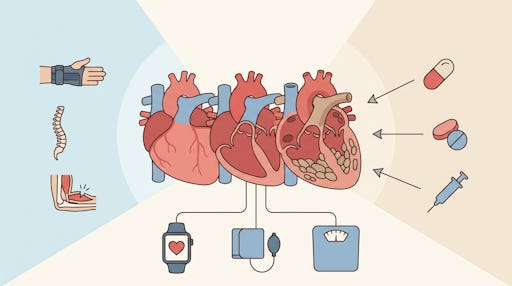
One hidden cause of this kind of heart trouble is something called cardiac amyloidosis. “Cardiac” means heart. “Amyloidosis” means an abnormal protein is building up where it doesn’t belong. Put together, it means a sticky material is collecting in the heart muscle.
That buildup makes the heart stiff. A stiff heart has trouble relaxing and filling with blood, so everyday things get harder. Walking from the car to the store can leave you winded. Your ankles may swell. You may feel worn out in a way that doesn’t match what you’re doing.
For years, this disease was often missed because doctors didn’t have much to offer once they found it. That’s changed. Newer treatments can slow the disease itself, not just ease the symptoms, and that is the real story here.
Stay confident with your tech, and keep your mind sharp. Premium subscribers get every Premium Guide, exclusive Brain Health and AI For Seniors Deep Dives, and full access to TechMaid for lifetime tech support (normally $50/year—yours free).
Why are people missing it for so long?
James Hicks, a 75-year-old former railroad worker in Arkansas, spent years being treated for heart failure before a cardiologist finally raised the possibility of cardiac amyloidosis. He had swelling, shortness of breath, and a racing heart, and he couldn’t walk from his grandson’s basketball game to the car without stopping several times.
What makes this disease so tricky is that the protein may show up in other parts of the body long before the heart becomes the obvious problem. Carpal tunnel syndrome, spinal stenosis, and even an unexplained biceps tendon tear can all be clues because the same material can crowd tight spaces in the body years before it stiffens the heart.
That doesn’t mean everyone with carpal tunnel has amyloidosis. It means the pattern matters. If heart failure shows up later, especially without a clear cause, those older problems are worth mentioning because they may help a doctor connect the dots.
A simple way to think about it is this: if you have unexplained heart trouble plus a history of nerve, tendon, or spine problems that never made much sense, that combination is worth asking about.
How can simple technology help earlier?
This is the part that often gets ignored. People live with symptoms every day, but doctors only see snapshots. A little personal technology can help fill in the blanks.
A smartwatch or fitness tracker can’t diagnose amyloidosis, but it can show patterns that matter. Resting heart rate trends, irregular rhythm alerts, and steady drops in daily activity can give doctors a better picture of what’s happening between visits. A home blood-pressure cuff and a scale help too, because changes in blood pressure and sudden weight gain can point to fluid buildup and worsening heart failure.
None of this needs to become a full-time job. One simple habit is enough. Track your weight, your walking, or your symptoms in a notebook or app. The useful part is not the gadget. It’s the pattern.
When it’s time to hand those numbers to your doctor, keep it plain. Bring a notebook with the last two to four weeks marked, print a one-page summary from your app if it offers one, or take a few clear screenshots showing dates and numbers, and send them through the patient portal before the visit. If your clinic uses a portal like MyChart, you may also be able to upload files or share data from connected devices directly.
The goal is not to overwhelm your doctor with raw data. It is to give a short story in numbers: “Here’s how my walking, weight, blood pressure, or heart rate changed over the last month.”
How are doctors diagnosing it now?
This is another place where things have improved. In the past, confirming amyloid in the heart often meant a heart biopsy, which sounds unpleasant because it is.
Now the first step is usually much simpler. Doctors start with blood and urine tests to look for abnormal proteins and rule out a fast-moving form of amyloidosis that needs urgent treatment. If those tests don’t point to that form, the next step is often a special nuclear scan, commonly called a PYP scan, that can show amyloid sitting in the heart muscle without having to biopsy the heart itself.
At a very high level, the blood test checks whether certain proteins are out of balance or showing up when they shouldn’t. You can bring this up with a doctor. That’s not being difficult. It’s being prepared. A reasonable question is: “Given my heart failure and my history of carpal tunnel or tendon problems, should we do the blood and urine tests for amyloidosis and consider the heart scan?”
Which medications are changing things?
Until a few years ago, treatment mostly meant trying to manage swelling, heart rhythm trouble, and shortness of breath. That helped some, but it didn’t go after the root of the disease.
Now there are medications that do. Tafamidis was approved in 2019, acoramidis in 2024, and vutrisiran in 2025 for this type of heart disease. Tafamidis and acoramidis help keep the problem protein in a safer shape so it is less likely to clump together, while vutrisiran helps the body make less of the protein in the first place.
That’s the simple version. One kind helps keep the mess from forming. The other kind helps reduce how much mess is being made. In clinical trials, these drugs improved survival and helped preserve quality of life compared with a placebo.
Marc Israel, diagnosed in 2020, was told he might live only 12 to 18 months without treatment. He got on tafamidis and was still alive five years later when The New York Times profiled him. That kind of story used to be unusual. Now it’s part of why doctors talk about patients living with this disease rather than dying quickly from it.
What does life look like after treatment?
People don’t experience this disease as a chart or a statistic. They experience it as stairs, parking lots, grocery aisles, and laundry baskets.
Mr. Hicks is a good example. After being treated for cardiac amyloidosis and atrial fibrillation, he got back to riding his e-bike about 100 miles a week and lifting weights at home. That doesn’t mean every patient returns to that level, but it does show what happens when a condition is finally recognized and treated instead of shrugged off as old age.
Doctors now say that many patients may eventually die with cardiac amyloidosis rather than from it. That’s a major shift. Not a cure, but a real improvement in how long and how well people can live.
What still gets in the way?
The drugs are effective, but they are also very expensive. The New York Times reported prices of roughly $250,000 to $500,000 a year, although Medicare coverage means many patients pay far less out of pocket. Even so, cost remains a real burden for patients and a serious issue for the health system.
Another problem is timing. These medications mostly slow or freeze the disease where it is. They do not remove all the material that has already built up in the heart. That is why earlier diagnosis matters so much. The sooner the heart is protected, the more function a person is likely to keep.
Researchers are now studying treatments designed to help clear amyloid that is already sitting in the heart. If those work, the next chapter in this story could be even better than the current one.
Frequently Asked Questions
Q: What does cardiac amyloidosis mean in plain English?
A: It means a sticky protein is building up in the heart and making it stiff.
Q: Can a blood test alone diagnose it?
A: Usually no. Blood and urine tests help rule out one type, and a PYP scan is often needed to confirm the common heart form.
Q: Should I mention carpal tunnel to a heart doctor?
A: Yes, if you also have unexplained heart failure or related symptoms, because it can be an early clue.
Q: Can a smartwatch detect amyloidosis?
A: No. It can show heart-rate, rhythm, or activity changes, but it cannot diagnose the disease.
Q: Do the new drugs cure it?
A: No. They slow the disease and help people live longer and better, but they are not a cure.
For reliable patient information, the National Heart, Lung, and Blood Institute offers clear public guidance on heart disease, and Apple Support explains how Apple Watch heart features work and what they can, and cannot, tell you.


Huh! That would explain a lot of stuff not just for me, but for my family too. Thanks!
At 79, I pay close attention to anything that helps separate “just aging” from something real. This piece does a good job of explaining that difference in plain English. I’ve had friends who were told their decline was normal, only to find out later it wasn’t. The encouraging part here is how much better the detection and treatment have become. It’s good to know that if something feels off, there are clearer paths now to figure out what’s going on. I had afib and two ablations to eradicate it. It worked, no more afib. I'm a fan.