

This is the last of a 4-part series on brain health. Earlier weeks covered sleep, physical exercise, and nutrition. It introduces our monthly Deep Dive into Brain Health, available to Paid subscribers.
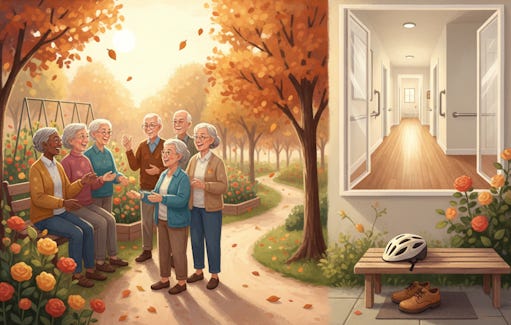
Most people trying to protect their brain health are focused on the wrong things. They’re buying supplements, doing crossword puzzles, or eating more blueberries. Not bad ideas, exactly. But two of the most powerful protective strategies get almost no attention: staying socially connected and preventing physical brain injury. Week four of our brain health series tackles both. And honestly, this might be the most practical week yet.
Become a Paid subscriber and keep your brain sharp with monthly brain health deep-dives and premium tech guides. Tech Maid 24/7 tech support (a $50/year value) included.
Your Brain Needs Other People
Think about the last time you had a genuinely good conversation. Not small talk. A real back-and-forth where you were thinking, listening, maybe even laughing. That kind of exchange is doing something important upstairs.
Social engagement activates multiple brain regions simultaneously. You’re processing language, reading emotional cues, retrieving memories, formulating responses. It’s a full-brain workout that no app can replicate.
Research from Rush University Medical Center found that people with frequent social activity had a significantly slower rate of cognitive decline than those who were more isolated. The effect was consistent even after accounting for physical health and education level.
Loneliness, on the other hand, is genuinely hard on the brain. Chronic social isolation is associated with higher levels of cortisol, the stress hormone, which over time can damage the hippocampus -- the part of your brain most involved in memory.
Community Involvement Does More Than Fill Time
Joining a club, attending a faith community, or showing up regularly to a local group gives your brain something predictable to anticipate and engage with. Routine social contact builds what researchers call cognitive reserve.
Think of cognitive reserve as a buffer. The more of it you build over your lifetime, the more your brain can tolerate damage -- from aging, small strokes, even early Alzheimer’s -- before symptoms appear. Social engagement is one of the best ways to keep adding to that reserve.
Asheville, for what it’s worth, has no shortage of ways to plug in. From community gardens to arts organizations to neighborhood groups still rebuilding after the flood, there are real opportunities to be around people doing meaningful work.
Volunteering Is Surprisingly Good Medicine
There’s a specific kind of benefit that comes from giving your time to something bigger than yourself. Volunteering has been shown in multiple studies to reduce depression, lower mortality risk, and, yes, support cognitive function in older adults.
A study published in the journal Psychological Science found that older adults who volunteered regularly showed better memory performance and higher levels of positive affect over time compared to those who didn’t.
It doesn’t have to be a major commitment. A few hours a week doing something you actually care about is enough to move the needle. The key ingredient is feeling useful and connected to other people.
Meaningful Relationships Are the Real Target
Not all social contact is equal. Acquaintances matter, but close, trusting relationships seem to carry particular weight for brain health. The quality of your connections counts as much as the quantity.
Friendship requires vulnerability, shared history, and genuine investment. Those things create ongoing mental engagement in ways that casual interaction doesn’t. Nurturing even two or three close friendships may do more for your long-term brain health than joining every club in town.
And if your social circle has shrunk -- which is incredibly common after retirement -- that’s worth actively addressing. Reconnecting with old friends, making new ones through shared interests, and staying in regular contact with people you care about aren’t just nice things to do. They’re brain health strategies.
The Threat You’re Probably Ignoring
Now let’s talk about the other half of this week’s topic, because it doesn’t get nearly enough attention in brain health conversations.
Physical injury to the brain raises your risk of cognitive decline and dementia. That’s not a minor footnote. Traumatic brain injury, even a mild concussion, can have lasting effects on brain structure and function. And the risk doesn’t disappear just because you’re not playing football.
Falls are the leading cause of traumatic brain injury in adults over 65. A fall that cracks your head on a bathroom floor or a concrete driveway is a serious neurological event. Most seniors don’t think of themselves as people who need to worry about this. But the statistics say otherwise.
Fall Prevention Is Brain Protection
Preventing falls is one of the most direct things you can do to protect your brain from injury. And most falls are preventable.
A few practical measures that actually work:
Remove throw rugs and clutter from walking paths in your home
Install grab bars in the shower and next to the toilet
Make sure your home is well-lit, especially at night
Wear shoes with non-slip soles, even indoors
Have your vision checked regularly, since poor vision is a major fall risk factor
Talk to your doctor about any medications that cause dizziness
Strength training and balance exercises, like tai chi or simple single-leg stands, can meaningfully improve your stability. This isn’t about vanity or fitness goals. It’s about keeping your brain safe.
Helmets and Seat Belts Aren’t Just for Kids
If you ride a bike, you wear a helmet. No exceptions. Same goes for e-bikes, which are increasingly popular and can reach speeds that turn a minor crash into a serious head injury.
Seat belts are non-negotiable in a car. In a crash, the difference between wearing one and not can easily be the difference between a bruised chest and a traumatic brain injury.
Some seniors also ride horses, ATVs, or motorcycles. All of these require appropriate head protection every single time. There’s no ride short enough or slow enough to skip it.
The brain doesn’t get a second chance. Once neurons are damaged by a significant impact, they don’t regenerate the way a broken bone does.
Putting It All Together This Week
Social connection and injury prevention might seem like unrelated topics, but they share something important. Both require you to be intentional. Neither happens automatically.
This week, pick one social commitment and actually put it on the calendar. Call someone you haven’t talked to in too long. Show up to something. And walk through your home with fresh eyes looking for fall hazards.
Your brain is worth protecting from the outside in, and from the inside out.

