

This is the second of a 4-part series on brain health. It introduces our monthly Deep Dive into Brain Health, available to Paid subscribers.
Your brain isn’t a fixed object that slowly deteriorates. It’s more like a muscle that responds to how you use it.
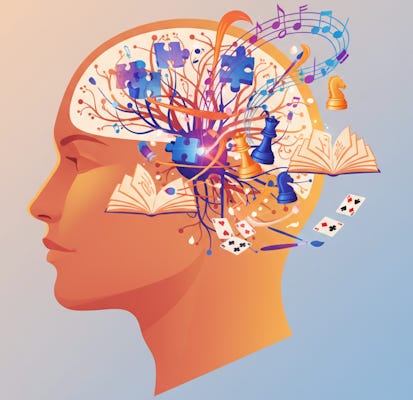
The difference between someone who stays mentally sharp at 75 and someone who struggles at 65 often comes down to one thing: cognitive reserve. Think of it as your brain’s savings account. The more you deposit through challenging activities, the better equipped you are to handle withdrawals from aging or disease.
Become a Paid subscriber and keep your brain sharp with monthly brain health deep-dives and premium tech guides. Tech Maid 24/7 tech support included.
What Happens When You Actually Challenge Your Brain
A 70-year-old who regularly engages in learning activities shows cognitive function equivalent to a 65-year-old who doesn’t. That’s not a small difference. That’s roughly six years of mental advantage earned through deliberate engagement.
The mechanism isn’t mysterious. When you challenge your brain with new information or skills, you’re triggering neuroplasticity—your brain’s ability to form new neural connections regardless of age. These connections don’t just help you complete today’s crossword puzzle. They build alternative pathways your brain can use when primary routes start showing wear.
Recent research from McGill University found that adults over 65 who used a speed-based brain training app for just 30 minutes daily showed measurable increases in cholinergic activity after 10 weeks. This type of brain signaling supports attention, memory, and cognitive control. It’s the first time any intervention has demonstrated this effect in humans.
The Activities That Actually Make a Difference
Not all mental activities provide equal benefits. Watching TV doesn’t count, even if it’s a documentary. Your brain needs genuine challenge.
Games and Puzzles That Work
Crossword puzzles, Sudoku, jigsaw puzzles—these aren’t just ways to pass time. A study of middle-aged adults at risk for Alzheimer’s found that people who regularly played games and puzzles showed better cognitive abilities and larger volumes in brain structures vulnerable to Alzheimer’s.
The key is working memory. When you’re solving a puzzle, you’re holding multiple pieces of information simultaneously, testing hypotheses, and adjusting strategies. That’s exactly the kind of cognitive workout that builds reserve.
But there’s a catch: once something becomes easy, it stops providing maximum benefit. Solved every Wednesday crossword without breaking a sweat? Time to move to Thursday.
Strategic Games Build Mental Flexibility
Bridge deserves special attention. The card game requires you to track partner bids, opponent distributions, previously played cards, and behavioral cues—all at once.
This isn’t just memorization. You’re making strategic decisions under uncertainty, calculating odds, and planning several moves ahead. These activities exercise executive functions like planning, inhibition, and mental flexibility, all associated with long-term cognitive health.
Chess, Go, and similar strategy games offer comparable benefits. The common thread? They force your brain to juggle complexity, recognize patterns, and adapt in real-time.
Lifelong Learning Creates Real Protection
Formal education doesn’t end at graduation. Community college classes, online courses, and workshop series all count.
The data is compelling. Later-life learning is associated with significantly better cognitive function over time, regardless of sex, race, ethnicity, or prior educational attainment. The cognitive benefit translates to approximately a six-year age difference in brain function.
What matters is novelty and challenge. Learning Spanish at 68? Your brain loves that. Taking a computer programming course after retirement? Even better. These activities force your brain to build entirely new neural pathways.
You don’t need a degree. A pottery class teaches hand-eye coordination, planning, and spatial reasoning. A photography workshop develops visual analysis and technical skills. The format matters less than the cognitive demand.
Creative Pursuits Engage Multiple Brain Regions
Painting, music, writing, sculpting. These artistic activities stimulate different areas of your brain simultaneously.
When you learn to play an instrument, you’re coordinating motor skills, reading notation, processing auditory feedback, and expressing emotion. That’s a comprehensive brain workout wrapped in an enjoyable activity.
Creative pursuits also offer problem-solving challenges. How do you mix that exact shade of blue? What chord progression fits this melody? These questions require both analytical and intuitive thinking.
Research shows that engaging in artistic activities improves memory, concentration, and problem-solving skills in aging adults. Creating art stimulates the brain in ways that enhance mental sharpness and cognitive vitality.
The Technology Connection
Brain training apps offer convenience but mixed results. While apps like BrainHQ have shown promise in controlled studies, most commercial brain games improve performance only on the specific tasks you practice.
The problem is transfer. Getting better at a memory game on your phone doesn’t necessarily help you remember where you parked your car. Studies suggest only 10-20% of users experience modest improvements that extend beyond the app.
That doesn’t mean technology is useless. Online learning platforms, language learning apps like Duolingo, and digital art tools all provide genuine cognitive challenges. The difference is they’re teaching real skills with broad application rather than isolated game mechanics.
Video calls for book clubs or chess matches combine cognitive stimulation with social interaction. Both are important for brain health. The technology becomes a tool for meaningful engagement rather than the engagement itself.
Building Your Mental Fitness Routine
Start with activities that genuinely interest you. Forced cognitive exercise won’t stick.
Try these approaches:
Schedule one cognitively demanding activity daily, even if it’s just 20 minutes
Rotate between different types of challenges (puzzles one day, learning the next)
Join groups that combine mental challenge with social interaction
Set learning goals that require sustained effort over weeks or months
Make it progressively harder as you improve
The consistency matters more than intensity. Twelve weeks of regular cognitive exercise show measurable brain benefits. But this isn’t a short-term project. The real advantage comes from making mental challenge a permanent habit.
Think about your daily routine. Where can you replace passive activities with active ones? Audiobook during your walk? Podcast while cooking? These small substitutions accumulate.
Why This Works (And Why It Matters)
Your brain builds cognitive reserve through three mechanisms: increasing neural efficiency, recruiting alternative brain networks, and maintaining existing function through ongoing repair.
When you regularly challenge yourself mentally, you’re not preventing brain changes from aging. You’re building redundancy so those changes don’t immediately impact function. It’s like having backup generators—when the main system falters, alternatives kick in.
This matters because cognitive decline isn’t inevitable at any specific age. Some 80-year-olds show minimal cognitive change. Others struggle in their 60s. Genetics plays a role, but so does lifestyle.
Cognitive stimulation can delay the onset of accelerated memory decline by years. In dementia patients, regular cognitive activities like crossword puzzles delayed onset by approximately two and a half years.
You can’t completely prevent Alzheimer’s or age-related cognitive decline through puzzles alone. But you can potentially delay onset, slow progression, and maintain better function throughout the process.
The Bottom Line
Your brain at 70 or 80 reflects decades of choices. What you learn, how you challenge yourself, and whether you stay mentally engaged all contribute to cognitive reserve.
Start now. Not because you’re worried about dementia in 20 years, but because challenging your mind makes today more interesting. The long-term benefits are a bonus.
Pick one new mental challenge this week. A puzzle book, a language app, a community college catalog, an art class. Make it something that requires genuine effort but offers genuine reward.
Your brain will thank you—both now and later.

