

Here’s a fun bit of math: if you’re a grandparent reading this, the kids in this article might actually be your great-grandkids. Gen Alpha covers anyone born from 2013 onward, which means the oldest of them are just hitting their early teens right now. We’re talking about kids who have literally never known a world without an iPad in the house.
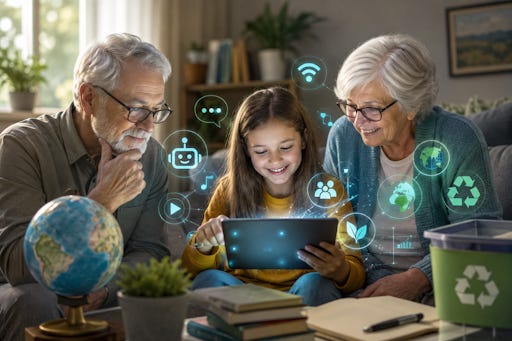
I want to be upfront that this one’s different from the others. Millennials and Gen Z, we’ve got data. Jobs, spending habits, voting patterns, the works. Gen Alpha? They’re still finger-painting. So consider this a preview, not a full portrait.
Keep your brain sharp with monthly Brain Health and AI For Seniors Deep Dives, and premium tech guides by becoming a Premium subscriber. TechMaid 24/7 tech support (a $50/year value) included.
Why Does This Generation Feel So Different?
Every generation gets shaped by the world dropped in their lap. Gen Alpha’s world includes a pandemic that hit during their formative years, climate change as a daily headline instead of a distant threat, and AI tools that write, draw, and talk back to them before they’ve learned cursive.
That last one matters a lot for you. Your grandkids grew up with search engines. These kids are growing up with conversational AI as a baseline expectation, not a novelty.
What Are the Early Signs Telling Us?
Researchers who track this stuff point to a few patterns worth watching:
Screen exposure starts earlier and is more personalized than any generation before, often through tablets designed for toddlers
Environmental awareness shows up young, kids as small as six or seven, talking about recycling and climate with real concern
Comfort with voice assistants and AI chat is instinctive, not learned, the way older folks had to learn to type
Attention spans are adapting to short-form video content in ways educators are still trying to figure out
Diversity and inclusion feel like water they swim in, not a topic they had to be taught
None of this means doom or triumph. It just means the furniture of their childhood looks nothing like yours or even your grandkids’ did.
What Does This Mean for You, the Grandparent?
Here’s where it gets personal. If you’ve got a great-grandchild or a young grandchild in this generation, your role isn’t to keep up with every app they touch. It’s to be a stable, curious presence while their world moves fast.
One actionable step: ask them to show you their favorite app or game, and just watch without judging. You’ll learn more in ten minutes of genuine curiosity than in an hour of worrying about “kids these days.”
How Does Tech Fit Into All This?
The tech overlap here is huge, honestly it’s the whole story. Gen Alpha won’t remember a “before AI” the way you remember life before the internet. They’ll grow up asking chatbots homework questions the way you once asked an encyclopedia, except the chatbot talks back and adjusts to them personally.
For you, this means the tech gap between generations might actually widen faster than it did with Millennials or Gen Z. But it also means there’s a real opening: if you get comfortable with AI tools now, even just basic ones, you’ll have something genuinely relevant to talk about with these kids as they grow.
What Comes After Alpha?
Researchers have already started using the term Gen Beta for kids born starting around 2025. We don’t know much yet beyond the label, but the pattern holds: each generation gets shaped by whatever tech and crisis define their childhood.
For seniors, the takeaway isn’t to predict the future perfectly. It’s to stay flexible, stay curious, and remember that every generation before this one seemed strange to the one before it too.


This is so true about the app-watching tip. I do the same thing with my pickleball students who bring their grandkids to watch clinics sometimes. You learn more by just sitting back and letting the kid show you their thing than by trying to control the conversation.
The "ten minutes of genuine curiosity" line is going to stick with me. A lot of my players in their 70s tell me they feel like they're always playing catch-up with their grandkids and great-grandkids, whether it's tech or just how fast everything moves now. Sounds like the same principle applies whether it's an iPad or a paddle. Show up curious, not corrective, and the connection happens on its own.
Funny enough, I see the reverse version of this on the court all the time. Older players learning pickleball from a grandkid who picked it up in gym class. The kid teaches, the grandparent watches without judging, and somehow that flips the whole dynamic in a good way.
Do you think Gen Alpha kids will actually end up teaching their grandparents AI tools the same way some of them already teach pickleball or video games, or is that too optimistic a bridge to expect?
Beautifully and wisely said.